
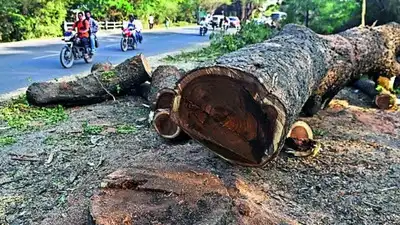
In 2023, Maharashtra amended laws regarding tree felling, eliminating mandatory independent reviews for large projects (Representative image)
MUMBAI: A state-level safeguard against large-scale tree felling in Maharashtra was removed in 2023 in the name of easing business and attracting investment, but records obtained under the Right to Information (RTI) Act show what the change took away: a mandatory independent review that could hold up projects until basic environmental conditions were met. In another case, it imposed conditions on the felling and transplantation of more than 1,200 trees, including the use of native species, geo-tagging and seven years of monitoring. The records, obtained by Jeetendra Ghadge of The Young Whistleblowers Foundation, highlight the significance of the Maharashtra (Urban Areas) Protection and Preservation of Trees (Amendment) Act, 2023. The amendment did not abolish the state authority, but removed its mandatory role in deciding proposals to fell more than 200 trees aged five years or older and proposals involving heritage trees. Under the 2021 amendments to the 1975 law, such proposals had to be referred to the state authority, which could approve or reject them. The provisions also required authorities to prevent projects from being split into smaller parts to keep the number of trees to be felled below 200. The relevant approval process carried a 45-day deadline. The legislative assembly passed the amendment bill on July 28, 2023. It received the governor’s assent and was published in the state gazette on August 25 that year. On July 15, 2022, the state authority deferred a National Highways Authority of India (NHAI) proposal to fell 608 trees, including five heritage trees, and transplant 968. On April 13, 2023, the authority cleared an NHAI proposal for the Amne-Bhoj section of a spur of the Vadodara-Mumbai Expressway. The proposal involved felling 506 trees, including three heritage trees, and transplanting 776.
Because land for compensatory plantation had not been identified, minutes of the Maharashtra State Tree Authority show that it deferred a highway proposal involving 608 trees. Because land for compensatory plantation had not been identified, it asked NHAI to coordinate with the Kulgaon-Badlapur chief officer and submit a plantation plan. The statement of objects and reasons, signed by then chief minister Eknath Shinde, said decentralising powers and reducing the number of permissions would promote ease of doing business, development and investment.
Ghadge said the state authority had provided an additional check on mass tree felling at a time when Maharashtra was experiencing the effects of climate change. Its records, he said, showed that it could withhold approval when essential conditions, such as identifying land for compensatory plantation, had not been met. Environmentalist Rajesh Ruparel said, “A sapling cannot replace a mature canopy.
It proposed empowering local tree authorities to permit felling without referring cases to the state body. When the body that wants the project also grants the permit, the tree has no advocate left. The amendment did not remove every environmental obligation. The consolidated law continues to require compensatory plantation and a minimum seven-year survival period for planted trees, with dead trees replaced. Geo-tagging and monitoring requirements also remain. These duties continue to apply to applicants and local tree authorities. What has changed is the mandatory state-level scrutiny of large and heritage-tree felling proposals. Local tree authorities now decide these cases without the former referral requirement, while the state authority retains other functions, including monitoring local tree authorities and protecting heritage trees.
The approval required native species at least six feet tall, plantation to begin within 15 days, geo-tagging to record the trees’ locations, seven years of monitoring and replacement of dead trees. The ninth meeting was held on July 31, 2023, three days after the assembly passed the amendment bill. It cleared proposals involving 753 trees: 382 for a sale building proposed by two Dadar housing societies and 371 for a Thane-Mulund railway station.
You Can Also Check: Gold Rate in Mumbai | Silver Rate in Mumbai | Bank Holidays in Mumbai | Public Holidays in Mumbai | Mumbai AQI | Weather in Mumbai | Petrol Price in Mumbai | Diesel Price in Mumbai | CNG Price in Mumbai | LPG Price in Mumbai Stay updated with the latest Mumbai news. By its ninth meeting, the authority was also requiring plantation to be completed before felling began and an indemnity bond to secure compliance. The minutes record three members present. The forest and urban development departments had been invited, but neither sent a representative. The RTI reply contains no minutes of any later meeting. For Mumbai and the wider metropolitan region, where road, rail, housing and infrastructure projects frequently compete with existing green cover, the distinction is significant: plantation conditions remain on paper, but the additional layer of scrutiny that once examined large proposals before approval has been removed. Download the TOI App.