
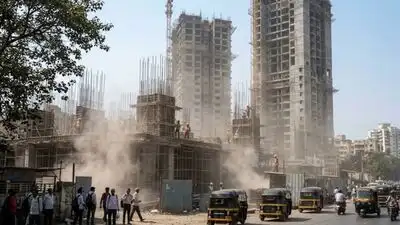
Mumbai AQI monitors show suspiciously low readings at sites (AI image)
MUMBAI: The city’s air-quality monitors threw up a startling contrast on Thursday: while AQI ranged fro m 57 in Malad to 153 in Worli, a sensor at a New Cuffe Parade construction site showed an almost pristine 16. Its PM2.5 and PM10 readings were 5.6 and 11.1. Across the road, an RMC plant recorded 49 and 60, while a nearby reading showed PM2.5 at 25.1 and PM10 at 6.3. The discrepancies in data raise questions about the calibration and reliability of the sensors used. “AQI 16 is practically impossible under the prevailing conditions. On Thursday, BMC announced plans to use AI-enabled analytics to monitor 3,000 sensors at infrastructure and construction sites, identify pollution hotspots and flag violations. A May 2025 circular mandates calibration every two months, comparisons with reference-grade monitors and periodic checks for equipment. BMC has empanelled 18 agencies to install sensors and directed officials to remove those repeatedly failing to calibrate or maintain equipment. Flying squads have inspected construction sites since Oct 1. Particulate matter is generally measured over 24 hours for comparison with national ambient air-quality standards. At two construction sites metres apart in Sewri, one recorded PM2.5 and PM10 readings of 60 and 71, while the other recorded 7 for both. On Wednesday, when the city’s officially reported AQI was 135, a construction site in Kamothe displayed PM2.5 at 13, PM10 at 11 and an AQI of 13.
Because of wind, weather and nearby emission sources, but large discrepancies warranted scrutiny: “Differences of 2-5 micrograms per cubic metre can be expected, dr Sagar A Marathe, assistant professor at Somaiya Vidyavihar University’s School of Basic and Applied Sciences, said pollution could vary over short distances.
Such a reading could indicate a calibration issue, sensor error or manipulation,” said additional municipal commissioner Avinash Dhakane. B N Kumar, environmentalist and director of NatConnect Foundation, said inadequate surveillance could allow readings to be manipulated. There should be standardisation of meters and BMC must check whether readings displayed are accurate,” he said. The boards appeared to have been installed as a formality, without adequate monitoring, he said.
The disparities raise questions about the reliability of sensor data underpinning BMC’s pollution-control efforts. Massive discrepancies could indicate low-quality sensors, power or voltage fluctuations, improper calibration, or incorrect placement and shielding. Sensor installation sometimes appeared to prioritise displaying readings over ensuring equipment functioned correctly. BMC’s guidelines acknowledge that poorly maintained, calibrated or unchecked sensors can under-report pollution. Dust on sensor optics and humidity can cause under-reporting, while voltage fluctuations can affect readings. Marathe called for clear technical specifications and sensor-placement guidelines. He cautioned against drawing conclusions from instantaneous readings. The discrepancies extend beyond New Cuffe Parade. “It’s possible to tamper with the meter settings. Concerns have also emerged in Navi Mumbai.
You Can Also Check: Gold Rate in Mumbai | Silver Rate in Mumbai | Bank Holidays in Mumbai | Public Holidays in Mumbai | Mumbai AQI | Weather in Mumbai | Petrol Price in Mumbai | Diesel Price in Mumbai | CNG Price in Mumbai | LPG Price in Mumbai Stay updated with the latest Mumbai news. Download the TOI App.