
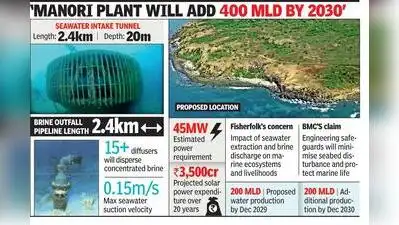
Mumbai: The proposed 200 million litres per day (MLD) desalination plant at Manori will draw seawater through a 2.4km intake tunnel at a depth of around 20m.
The intake pipeline will be 2,360m long and the outfall pipeline will extend 2,420m from the landfall point, according to BMC. The brine discharge point will be located 728m north of the intake heads, with more than 15 diffuser units designed to disperse the concentrated saltwater. The civic body said the project will use tunnelling rather than conventional dredging for the first 2,000m of the intake and outfall pipelines.
Amid opposition over the potential impact of seawater intake and the discharge of concentrated brine on marine ecosystems and fishing livelihoods, BMC is incorporating advanced engineering measures for marine protection, said additional municipal commissioner Abhijit Bangar. The project’s environmental impact assessment identifies no coral reefs, turtle nesting grounds or seagrass beds at the proposed site, and the nearest mangrove patch is about 505m away, said BMC. Geotechnical surveys for the project have begun. Pipe-jacking method will help avoid disturbing the seabed and the organisms living on it. Mechanical rock-cutting methods will be used instead of blasting. It also cited modelling studies to allay concerns over brine discharge. Residual chlorine will have to be neutralised before release to limit its toxicity to sensitive marine organisms.
Mumbai receives around 4,100 MLD of water from its seven reservoirs. “We are trying to ensure that by 2030, the supply reaches 5,140 MLD. Of this, 600 MLD should come from desalination plants at Gorai and Versova and 440 MLD from the Gargai project,” said Bangar. The Manori project is expected to add 200 MLD once operational in Dec 2029. Another 200 MLD will be ready by Dec 2030.