
Nagpur: At a time when Nagpur is staring at acute water scarcity, its 5,948 wells and borewells could offer an alternative source of water. However, uncertainty over groundwater quality raises questions about whether these sources can safely supplement surface water supplies, particularly when reservoirs are holding less than half their capacity.
A pre-monsoon assessment in 2024 analysed 65 groundwater samples for heavy metals. CGWB reported that the tested metals, including arsenic, chromium, lead, mercury, nickel and manganese, were within prescribed limits. You Can Also Check: Gold Rate in Nagpur | Silver Rate in Nagpur | Bank Holidays in Nagpur | Public Holidays in Nagpur | Petrol Price in Nagpur | Diesel Price in Nagpur | CNG Price in Nagpur | LPG Price in Nagpur Stay updated with the latest Nagpur news.
However, the available findings do not establish whether locations where excessive fluoride was detected were retested. CGWB has recommended periodic groundwater sampling, immediate sealing of contaminated wells and blending contaminated groundwater with surface water where appropriate. Other recommendations include rooftop rainwater harvesting, water reuse and recycling, dual supply systems for drinking and other domestic purposes, and measures to prevent wastage. Download the TOI App.
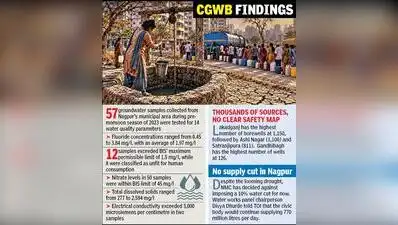
57 groundwater samples collected from Nagpur’s municipal area during the pre-monsoon season of 2023 were tested for 14 water quality parameters, according to CGWB’s court submission. Fluoride concentrations ranged from 0.45 to 3.84 mg/l, with an average of 1.97 mg/l. Twelve samples exceeded Bureau of Indian Standards’ (BIS) maximum permissible limit of 1.5 mg/l, while eight were classified as unfit for human consumption. Nitrate levels in 50 samples were within the BIS limit of 45 mg/l. Total dissolved solids ranged from 277 to 2,594 mg/l, while electrical conductivity exceeded 3,000 microsiemens per centimetre in two samples from east Nagpur. Uranium concentrations were below the BIS permissible limit of 30 parts per billion.
Findings submitted by Central Ground Water Board (CGWB) in connection with a PIL filed by resident Sandesh Singalkar before the Nagpur bench of Bombay High Court have revealed excessive fluoride levels in several groundwater samples. The report, however, does not establish whether fluoride alone was responsible for declaring water unfit.