
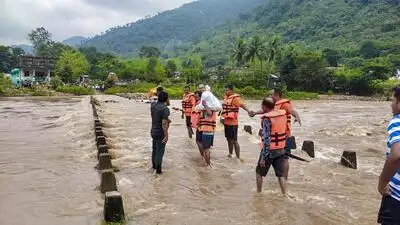
Odisha Disaster Rapid Action Force (ODRAF) personnel conduct a rescue and relief operation in a flood-hit area after cyclone Arnab
It may lead to rainfall in parts of Maharashtra over the next few days. Pune: Days after Cyclone Arnab struck the Andhra Pradesh coast, a fresh weather system is likely to develop over the Bay of Bengal, IMD said on Saturday.
In an earlier bulletin issued on Oct 31, the weather department issued a pre-cyclone watch (yellow message) for the Andhra Pradesh coast.
IMD officials said it was too early to assess its impact on the state as the system’s movement and track were yet to become clearer. The system is expected to lose considerable intensity by the time it moves inland,” an IMD official said. When a cyclone moves slowly, the landfall process becomes longer and the impact of wind and rainfall can be greater,” he said.
For Maharashtra, the evolving track of the system will be crucial. “Another two days are needed for the track to become clearer. Any possible impact on Maharashtra would be in terms of rainfall. The IMD will provide a more precise location, timing, and advisory as and when fresh assessments are issued. He also highlighted the growing concern over extremely severe cyclones slowing down as they approach India’s east coast. “The recent Cyclone Arnab is the best example. We saw how it took six hours to complete the landfall process over Andhra Pradesh.
“Rainfall activity over Andhra Pradesh is likely to be higher on Nov 2 and 3. South Odisha is expected to receive heavy to very heavy rainfall on Nov 3 and 4. Very heavy rainfall could reach 200-300mm at some places in these regions,” Mohapatra told TOI .
Mohapatra said India usually records four to five cyclones annually, with three to four typically developing during the Oct-Dec post-monsoon season and one to two during the pre-monsoon period (April-June). On long-term trends and climate change, Mohapatra said the overall number of cyclones is declining, but the number of intense cyclones is either remaining the same or increasing. However, there were no cyclones during either the pre-monsoon or monsoon season this year. Arnab was the first, and the new system would be the second.