
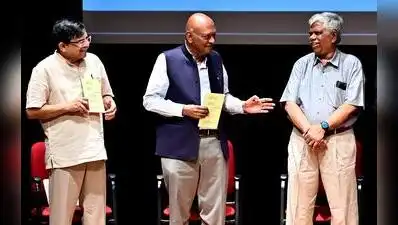
Justice S Muralidhar, former Chief Justice of Orissa high court, Raju Ramachandran, senior advocate, Supreme Court of India, and Justice K Chandru, former judge of the Madras high court at Colloquium ‘Who Will Judge the Judges’ organised by the Asian College of Journalism, Chennai.
He said the Modi govt, after coming to power in 2014, attempted to introduce the National Judicial Appointments Commission (NJAC), but Supreme Court struck down the legislation. “There are 38 judges in Supreme Court and about 1,000 judges in high courts.
“Since then, all Supreme Court and high court judges were directly appointed by Modi, not the collegium,” Justice Chandru said. He said the govt had made no attempt to revive the NJAC as it had found ways that were more profitable than the commission. Criticising the collegium system of judicial appointments, he said the process lacked transparency and was not recognised by the Constitution. It is the best ever secret kept in the country,” he said in his keynote address at a colloquium titled ‘Who Will Judge the Judges’, organised by Asian College of Journalism (ACJ). Earlier, delivering a keynote address on the title ‘Primus inter pares: A Critique of the office of the Chief Justice of India’, former Chief Justice of Odisha high court S Muralidhar said the country was slated to have a slew of chief justices who had never headed a high court. Pointing out the lack of an adequate number of woman judges in Supreme Court, Justice Muralidhar said, “Former CJI D Y Chandrachud was in office for two years.
The appointment process takes place without anyone knowing anything through a collegium system which is not recognised by the Constitution. But he could not find a single woman judge suitable to be elevated to Supreme Court. Diversity is only for public consumption. Raju Ramachandran, senior advocate, Supreme Court, spoke on the title ‘Unwillingness or Inability? Why Impeachments Fail’, while Justice K Kannan, former judge of Punjab and Haryana high court, addressed the gathering on the title ‘Preparing the Judges to Judge’. Senior advocate of Madras high court R Vaigai delivered a keynote address on ‘How Fair is the Quality of Justice: lack of diversity in appointments’.
Chennai: Judges of Supreme Court and high courts are, in effect, being appointed directly by Prime Minister Narendra Modi rather than the collegium, said former judge of Madras high court K Chandru on Saturday.