
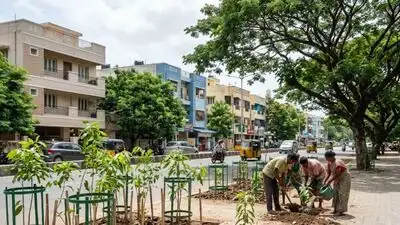
Chennai’s urban green policy aims for better tree coverage and maintenance across all city zones (AI image)
First, tree canopy should cover 30% of every urban neighbourhood; every resident should see at least three mature trees at home or work; and lastly, the maximum distance between two green spaces in a city should be 300m. It said only 6,634.52 hectares of the city (15%) had green cover, and that 2,015 hectares could be added.
“We focus on blue-green areas, along waterbodies and canals, educational institutions, govt offices or state highways,” a GTM official said. “We cannot target core urban areas due to underground cables and pipelines,” he said. In 2026, a study by Anna University’s Centre for Climate Change and Disaster Management put Chennai in a “high-priority” zone and called for immediate urban forestry measures. Chennai district forest officer V A Saravanan said the forest department supplies saplings to civic bodies and farmlands, and rangers help protect and maintain them. Environmentalists said the city must first protect the trees it already has. “In several places, cable wires wrap tree trunks and posters hang from nails,” said T D Babu, a trustee of Nizhal, a non-profit organisation working on urban greenery. “Concrete and pavements cover the base of trunks, leaving the roots no room to breathe. ” GCC commissioner G S Sameeran said people who damage trees on govt land face a ₹15,000 fine, and unauthorised felling carries a penalty of up to ₹1 lakh. Each zone has a park overseer authorised to collect fines, and zonal officers have been told to protect tree cover, he said. A new census is coming, assistant conservator of forests R Mahendran said. “We will first build satellite imagery of the green cover, then do ground truthing, which is where the trees are actually counted,” Mahendran said
These replies clash with the spirit of the state’s urban green policy, drafted by the Green Tamil Nadu Mission (GTM), which pushes for counting and maintaining trees. The policy has three key targets. Civic officials blame rapid, unplanned urbanisation. The agency coordinates planting with local bodies and state agencies. Research suggests the city needs to move faster. The govt joined hands with TERI (The Energy and Resources Institute, formerly Tata Energy Research Institute) for it.