
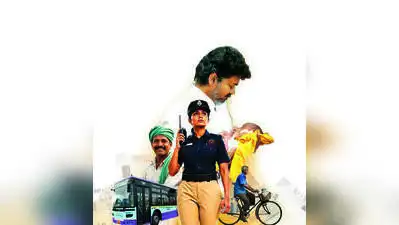
Expenditure control, however, is more important — and more challenging — given the large number of electoral promises in the pipeline
The implementation of a plethora of cash-disbursement and welfare schemes, driven more by political considerations than by the larger interest of the State’s fiscal stability, resulted in revenue projections falling short of expectations amid uncontrolled revenue expenditure during 2025-2026, the election year. K Shanmugam and K R Shanmugam The TVK-led govt in Tamil Nadu has inherited a financial position from the previous regime that can best be described as unsteady. The fragile fiscal position has made it difficult for the new govt to implement even its liberal electoral promises.
The govt’s White Paper released June 16, says the state’s fiscal deterioration in 2025-2026 was worse than its position in 2020-2021, the year of the pandemic. The revenue deficit, which stood at `62,326 crore in 2020-2021 and was considered unprecedented at that time, increased to `69,219 crore according to the pre-audit figures for 2025-2026. The White Paper also highlighted that outstanding liabilities increased to `13.2 lakh crore, including the committed debt liabilities of state PSUs such as the power utility and transport corporations. It further raised concerns over the declining tax-to-GSDP ratio, which had fallen to 5.5%, along with the growing burden of committed expenditure, especially interest payments. The previous govt, for instance, began implementing several of its major electoral promises, including the monthly assistance to women, only from 2023, the third year of its tenure. On the revenue side, the revised budget estimates for 2026-2027 project an additional `1,000 crore through higher excise duty on IMFL sales, which appears realisable, and another `15,000 crore through procedural reforms in GST, Stamp and Registration fees and motor vehicle tax revenues are relatively on the higher side. Consequently, state own tax revenue (SOTR) is estimated at `2.3 lakh crore in 2026-2027, which is `2,839 crore lower than what was projected in the interim budget. Revenue expenditure in the revised budget estimates for 2026-2027 stands at `4 lakh crore, `12,530 crore higher than the interim budget estimate. Consequently, the revenue deficit has increased to `55,775 crore, or 1.4% of GSDP, from the interim budget. nearly half of the net borrowing is being used to meet revenue expenditure, with only the balance supporting investment Although the fiscal deficit is projected at 3% of GSDP. Public debt is projected to reach `11 lakh crore by the end of the current financial year, equivalent to 27% of GSDP and within the stipulated limit. This is above the sustainable level of 23% estimated by empirical studies for the state.
The resulting SOTR growth rate of 9.8% is, therefore, relatively reasonable. Unless the govt makes a serious attempt to restore balance in the revenue account, fiscal deterioration is likely to continue, particularly if additional welfare schemes are introduced. It noted that while peer states such as Gujarat, Karnataka and Maharashtra had consolidated their fiscal positions, Tamil Nadu had moved in the opposite direction. The broad prescription was to augment revenue resources by plugging leaks and improving expenditure management. The normal expectation from a newly elected govt is that it will redraw the fiscal roadmap and consolidate the state’s finances by taking bold steps to reduce unproductive expenditure and augment revenue. People are generally more willing to accept such difficult measures from a new govt. Once fiscal stability is restored, the govt can proceed with implementing its electoral promises, many of which involve substantial revenue expenditure. Surprisingly, the newly elected govt has begun prioritising some of its heavy budget welfare promises while continuing almost all existing schemes, without first addressing the underlying fiscal concerns. Under these circumstances, it is doubtful whether revenue growth will fully address the concerns of higher commitments on revenue expenditure. Revenue expenditure being the concern, state attention is needed to control expenditure. With no visible expenditure-control measures, debt is likely to increase further. This leaves little headroom for introducing development projects or schemes without adversely affecting fiscal stability.
With net debt additions exceeding `1 lakh crore annually, the interest burden will continue to rise. Interest payments are projected to account for 22.5% of revenue receipts in 2026-2027, substantially above the normal expected range of 10%-14%. Before the budget, the govt announced several schemes, including 200 units of free power for domestic consumers at `1,730 crore; Thai Maman gold ring and baby kit for newborns costing `560 crore; Annan Seer with gold coins for girls’ marriages at `812 crore; and a crop-loan waiver estimated at `6,220 crore. After the budget, it announced free bus travel for all women in the state, estimated to cost `6,000 crore, and three LPG cylinders annually for households, costing `4,000 crore. The chief minister’s comprehensive health insurance scheme has also been enhanced from `5 lakh to `25 lakh per family which will have substantial financial implications. Several major promises remain in the pipeline, including increasing monthly assistance to women from `1,000 to `2,500; raising old-age pension to `3,000 per month; providing `15,000 school grants to parents and 79 lakh farmers; monthly unemployment assistance of `3,000 for graduates; `27,000 annual assistance to fishermen; and `16,000 crore education-loan. Collectively, these commitments could impose an additional burden of at least `1 lakh crore annually on the state exchequer.
The govt may therefore have to explore unconventional measures, including eliminating corruption, improving tax compliance and strengthening non-tax revenue sources through infrastructure and amenities charges, betterment taxes, and seigniorage charges on mines and minerals. Time will tell how effectively the new govt balances welfare commitments with fiscal consolidation to restore the state to a path of sustainable economic development and long-term financial stability. (K Shanmugam is former chief secretary, GoTN; K R Shanmugam is former director, Madras School of Economics) You Can Also Check: Gold Rate in Chennai | Silver Rate in Chennai | Bank Holidays in Chennai | Public Holidays in Chennai | Chennai AQI | Weather in Chennai | Petrol Price in Chennai | Diesel Price in Chennai | CNG Price in Chennai | LPG Price in Chennai Stay updated with the latest Chennai news. they fall short of some of the promises made in the election manifesto and could have political implications While these measures target specific beneficiaries. Other popular initiatives include Singapen Padukkapu Thittam and the special wing for drug control, which involve reorganisation of the existing system and have relatively limited financial implications. Given the present fiscal position, fulfilling them will be a formidable challenge. Restoring revenue balance should be the govt’s priority. This can be achieved through a combination of revenue augmentation and expenditure rationalisation. The scope for revenue enhancement through conventional tax revisions is limited. The govt has constituted a committee under the chairmanship of economist Montek Singh Ahluwalia, to examine ways of improving revenue mobilisation. Its recommendations and their effectiveness in strengthening the state’s resources will be watched. Expenditure control, however, is more important — and more challenging — given the large number of electoral promises in the pipeline. Nevertheless, the govt needs to undertake a comprehensive review to identify and eliminate less productive schemes and expenditures. With the revenue budget already strained, the new govt should explore off-budget resources by reviving the Tamil Nadu Infrastructure Development Board and Tamil Nadu Infrastructure Fund Management Corporation to accelerate infrastructure investment and boost the economy. Download the TOI App.