
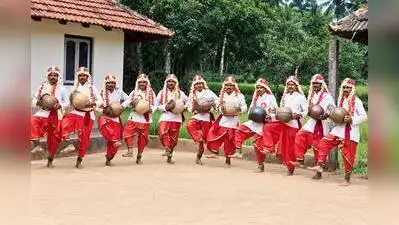
Members of the Konkani Kudumbi community perform a traditional dance
Researchers analysed maternally inherited mitochondrial DNA (mtDNA) from 295 Konkani individuals and compared it with genetic data from more than 5,000 individuals across Eurasia. Prof Mustak said a substantial share of maternal diversity could be traced to an ancient source population that likely lived in the Near East during the Last Glacial Maximum, around 26,500 to 19,000 years ago. These maternal lineages are believed to have entered South Asia during the subsequent warming period between 19,000 and 11,000 years ago, with later movements continuing through the Holocene.
You Can Also Check: Gold Rate in Hyderabad | Silver Rate in Hyderabad | Bank Holidays in Hyderabad | Public Holidays in Hyderabad | Hyderabad AQI | Weather in Hyderabad | Petrol Price in Hyderabad | Diesel Price in Hyderabad | CNG Price in Hyderabad | LPG Price in Hyderabad Stay updated with the latest Hyderabad news.
“By examining complete mitochondrial genomes, we uncover the rich ancestry that both unites and distinguishes Konkani communities, shaped by geography, climate, and culture over millennia,” said first author Jaison Sequeira. Researchers’ contribution According to Thangaraj, the findings provide evidence that ancient migrations into South Asia involved both maternal and paternal contributions, offering a more complete picture of population movements in the region. CCMB director Vinay Kumar Nandicoori said the research contributes to a better understanding of the ethnolinguistic history of India’s western coast and the demographic processes that shaped contemporary Konkani-speaking communities.
Hyderabad : Ancient migrations into the Indian subcontinent were not driven by men alone. A new genetic study led by Hyderabad’s CCMB has found that women, too, were part of the population movements that shaped the ancestry of Konkani-speaking communities along India’s west coast, leaving distinct maternal genetic signatures that survive to this day. Published in ‘Heredity’, the study was led by K Thangaraj of the CSIR-Centre for Cellular and Molecular Biology (CCMB), Hyderabad, and Professor MS Mustak of Mangalore University. Shared roots, diverse ancestry Stretching from Daman in the north to Karwar in the south, the Konkan coast is home to a diverse Konkani-speaking population comprising multiple social, migratory and religious groups. their genetic history has remained largely unexplored While linguistic and cultural variations across these communities are well documented. The researchers examined both Sarasvata and non-Sarasvata groups, a distinction rooted in oral traditions linking some communities to the ancient Sarasvati river region. Sarasvata groups displayed slightly stronger links to West Eurasian and Steppe-related maternal lineages While the study found that maternal ancestry was predominantly South Asian. Evidence of migration, isolation Comparisons with Eurasian populations reinforced the finding that the Konkani maternal gene pool reflects contributions from both long-established South Asian lineages and West Eurasian ancestry. The study also identified the effects of founder events and long-standing endogamy on genetic diversity among occupational communities such as the Kharvi and Kudubi. In contrast, Gauda Sarasvata Brahmins and Roman Catholics exhibited greater genetic diversity than other Konkani groups included in the study. The study was co-authored by linguist Prof George van Driem of the University of Bern and Lomou Kumar of the Birbal Sahni Institute of Palaeosciences, Lucknow. Download the TOI App.