
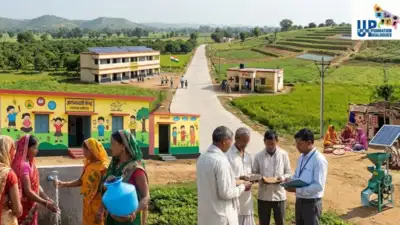
(AI-IMAGE) Since its launch in January 2018, the Aspirational Districts Programme has driven positive change throughout Uttar Pradesh
When the Aspirational Districts Programme (ADP) was launched in January 2018, its central objective was to accelerate development in regions that had lagged behind on important social and economic indicators. Out of a total of 112 districts in the country, eight districts of Uttar Pradesh—Bahraich, Balrampur, Chandauli, Chitrakoot, Fatehpur, Shravasti, Siddharthnagar and Sonbhadra—were included in the programme. By March 2026, all eight had registered improvements in their composite development scores compared with their June 2018 baselines, according to figures cited in a Lok Sabha answer in August 2026. Siddharthnagar recorded an improvement of 82 per cent over its baseline score, rising from 35.70 in June 2018 to 64.84 in March 2026. Sonbhadra improved by 76 per cent, from 38.00 to 67.06, while Bahraich registered a 75 per cent improvement, increasing from 37.40 to 65.63. Shravasti’s score rose from 37.10 to 61.11, representing a 65 per cent improvement. Balrampur recorded a 62 per cent increase, moving from 36.00 to 58.37, while Fatehpur improved by 60 per cent, from 41.00 to 65.62. Chandauli’s score rose from 42.40 to 66.42, an improvement of 57 per cent, and Chitrakoot registered a 51 per cent improvement, moving from 44.70 to 67.48. The ADP currently monitors 49 key performance indicators, according to NITI Aayog’s programme framework.
Rather than treating development as a question of expenditure alone, the programme introduced a system that measured outcomes, identified gaps and encouraged district administrations to improve their performance continuously. The extent of improvement varied across districts, but the figures provide a measurable basis for examining how development priorities have evolved over eight years. The composite scores reveal substantial gains across the eight districts. These figures illustrate the progress recorded under the programme’s composite scoring framework. They should not, however, be interpreted as equivalent percentage increases in household income or overall living standards. Composite scores measure performance across selected development indicators; actual outcomes must also be assessed through individual indicators, service quality and the experiences of residents. The programme’s defining feature is its emphasis on three principles: convergence, collaboration and competition. NITI Aayog coordinates the initiative with central ministries, state governments, district administrations and development partners. Districts are monitored through the Champions of Change Dashboard, which tracks progress across five themes: health and nutrition, education, agriculture and water resources, financial inclusion and skill development, and basic infrastructure. This framework encourages district officials to identify specific shortcomings rather than rely exclusively on broad development targets. If immunisation coverage, school facilities, agricultural services or access to banking remains inadequate, the administration can focus its attention on those indicators and coordinate the relevant departments. The use of delta rankings also changes the way progress is evaluated. Instead of looking only at a district’s existing level of development, the system measures how far it has progressed from its baseline. This allows districts starting from different levels to demonstrate improvement while retaining the need to strengthen services and close persistent gaps. The dashboard provides a common reference for officials to assess progress, identify areas requiring intervention and learn from practices adopted by other districts. Health and nutrition are among the programme’s principal areas of intervention. The emphasis is on improving the reach and reliability of essential services, including maternal healthcare, antenatal registration, supplementary nutrition, childhood immunisation and the functioning of frontline health facilities. For districts such as Bahraich, Shravasti and Balrampur, where improving access to public services is an important development priority, these indicators help administrators identify gaps in service delivery and direct attention towards underserved communities. The approach also reinforces the importance of coordination between health departments, Anganwadi centres and local administrations. Improved monitoring can help officials identify missed immunisation targets, gaps in nutritional support and weaknesses in the delivery of maternal and child health services. However, the number of facilities established or beneficiaries registered does not by itself demonstrate better health outcomes. Sustained progress also depends on adequate staffing, the availability of medicines, regular monitoring and the quality of care provided to patients. Education is another major pillar of the programme. Its indicators bring attention to school infrastructure, electricity, access to textbooks and other conditions that influence children’s participation in education. In districts where geographical distance and inadequate facilities can create barriers to schooling, a targeted approach can help officials identify schools that need attention and coordinate corrective measures. The programme also connects district development with financial inclusion and skill development. Access to banking services, credit and livelihood opportunities is particularly relevant in areas where households depend heavily on agriculture and informal employment. These interventions are intended to improve the conditions in which people live and work. Their long-term value, however, depends on whether improved access to education translates into better learning outcomes and whether skill training leads to sustainable employment or self-employment. Agriculture and water resources remain central to development in rural Uttar Pradesh . The programme’s monitoring framework brings attention to agricultural services, water management and the availability of resources that can support rural productivity.
The programme’s approach was subsequently extended to the sub-district level through the Aspirational Blocks Programme, launched in January 2023. In Uttar Pradesh, the scale of implementation was evident during a review conducted in June 2025. Officials inspected 272 schools, 301 Anganwadi centres, 232 health units, 229 gram panchayat secretariats and 275 other institutions across 108 aspirational development blocks, according to the state government’s report. The review also reported 497 active farmer producer organisations and 6,595 Banking Correspondent Sakhis working to advance financial inclusion. A total of 106 blocks had achieved their targets under the Block Development Strategy.
For farming households, better coordination among agricultural departments, access to financial services and effective delivery of government schemes can help address practical constraints. The challenge is to ensure that these services result in improved productivity, more reliable irrigation and stronger farm incomes. Basic infrastructure is equally important. Reliable electricity, drinking water, sanitation and road connectivity affect access to schools, healthcare, markets and public services. These facilities can also help local enterprises operate more efficiently. Financial inclusion adds another dimension to the development process. Access to banking services and institutional credit can make it easier for eligible households and small businesses to participate in formal economic activity. Yet access alone is not sufficient: the benefits depend on whether people can use these services regularly and obtain suitable financial support. This initiative seeks to address development gaps within districts by focusing on underserved blocks and monitoring progress across health and nutrition, education, agriculture and allied services, basic infrastructure and social development. These figures demonstrate the scale of administrative monitoring and institutional activity. They also show why the block-level approach matters: district-wide averages can conceal considerable differences between villages and local communities. The state’s review process has included inspections by senior officials, assessment of vacant posts, scrutiny of scheme implementation and directions for more regular monitoring. Such measures seek to connect performance data with administrative action on the ground.
The Next Challenge: Making Progress Sustainable
The experience since 2018 suggests that the Aspirational Districts Programme has helped institutionalise a more focused approach to development planning. The national Sampoornata Abhiyan 2.0, launched in January 2026 for a three-month period ending on April 14, 2026, reinforced the focus on saturating selected indicators in aspirational districts and blocks. Since 2018, the programme has established a framework for measuring progress and directing attention towards neglected development gaps.
The enduring test will be whether these gains are maintained, inequalities within districts are reduced and better public services translate into tangible improvements in everyday life. (District Transformation) You Can Also Check: Gold Rate in Lucknow | Silver Rate in Lucknow | Bank Holidays in Lucknow | Public Holidays in Lucknow | Lucknow AQI | Weather in Lucknow | Petrol Price in Lucknow | Diesel Price in Lucknow | CNG Price in Lucknow | LPG Price in Lucknow Stay updated with the latest Lucknow news. Uttar Pradesh’s eight districts have all improved their composite scores, and the extension of the model to blocks has brought greater attention to localised development gaps. Yet improvement in indicators is only one part of the task. The next phase requires consistent service delivery, adequate staffing, maintenance of public infrastructure and closer assessment of whether schemes are reaching their intended beneficiaries. It also requires attention to differences within districts, particularly between better-connected centres and remote rural communities. Its priorities included maternal and child health, tuberculosis case notification, health and nutrition outreach, functional facilities at Anganwadi centres and schools, and vaccination of bovine animals. For Uttar Pradesh, the larger objective is to translate administrative progress into lasting improvements in human development and economic opportunity. That means ensuring that better scores correspond with healthier mothers and children, stronger schools, more productive farms, accessible banking services and dependable basic infrastructure. The evidence from Uttar Pradesh’s aspirational districts shows that measurable improvement is possible. Download the TOI App.