
Attachment
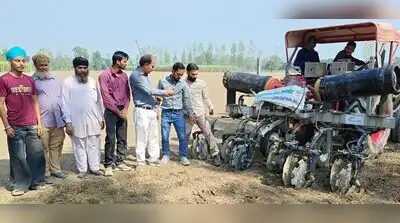
Under the programme, Manjit Singh Sandhu, a farmer from Bela Pokhra village in Amaria tehsil, has been selected for the trial and demonstration of anhydrous ammonia application on 16 hectares during the ongoing Rabi season under the supervision of scientists from the Krishi Vigyan Kendra (KVK). We therefore plan to organise groups of small and marginal farmers and introduce the technology through a community-based system,” said Dr Shailendra Singh Dhaka, a KVK scientist in Pilibhit.
The ammonia is absorbed by soil particles, making nitrogen available for uptake by crops,” said Dr Meraj Ansari, principal scientist at ICAR-Indian Institute of Farming Systems Research. The technology was recently demonstrated before Union agriculture minister Shivraj Singh Chouhan by ICAR scientists, Ansari said, adding that scientists are also assessing whether the use of green ammonia — produced with renewable energy — could help reduce the carbon footprint associated with fertiliser production and support the objectives of the National Green Hydrogen Mission. Scientists said anhydrous ammonia is a toxic and corrosive chemical, accidental exposure of which can cause burns to the skin and eyes, respiratory injuries and potentially life-threatening lung complications.
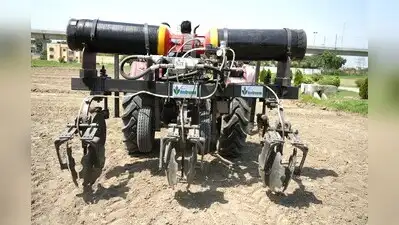
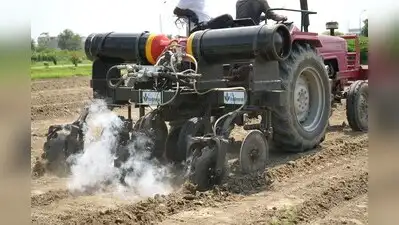
“The technology involves injecting anhydrous ammonia approximately 15cm beneath the soil surface through specialised tractor-mounted applicators. The pilot follows experiments on wheat, paddy, maize and sugarcane conducted by five Indian Council of Agricultural Research institutes — ICAR-Indian Institute of Soil Science, Bhopal; ICAR-Central Rice Research Institute, Cuttack; ICAR-Indian Institute of Farming Systems Research, Modipuram; ICAR-Indian Institute of Sugarcane Research, Lucknow; and ICAR-Central Institute of Agricultural Engineering, Bhopal. Its application requires pressurised storage tanks, calibrated metering systems, specialised tractor-mounted applicators, trained operators, protective equipment and strict safety protocols. “The movement of a tanker-mounted applicator may prove difficult in areas with fragmented landholdings, narrow field bunds and inadequate turning space.
Anhydrous ammonia, which contains about 82% nitrogen by weight, compared with 46% in granular urea, will be injected directly into the soil using specialised tractor-mounted applicators. Scientists say subsurface application could reduce nitrogen losses through volatilisation and improve fertiliser-use efficiency, while further reducing import dependence and enhancing India’s agricultural security.