
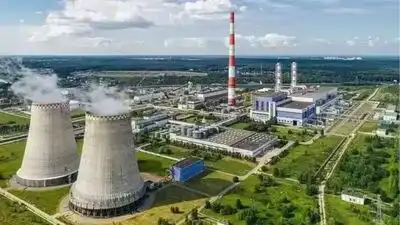
Sonbhadra, once primarily known for its vast mineral resources, thermal power stations and forested landscape, is undergoing a significant transformation under the leadership of Chief Minister Yogi Adityanath. Over the last nine years, the district has increasingly moved towards a broader development model in which energy, industry, infrastructure, investment and employment are being brought together to create a more diversified local economy.
Sonbhadra is now moving rapidly towards the Rs 20,000 crore investment target assigned for Ground Breaking Ceremony (GBC) 5.0. MoUs have already been signed for 33 projects involving proposed investments of Rs14,612 crore, leaving an investment gap of Rs 5,388 crore. Major investments changing Sonbhadra’s industrial landscape Among the most significant proposals is the Rs 7,400 crore investment by the Adani Group for a Pumped Storage Power (PSP) plant at Panaura. Another major proposal is the Rs 6,400 crore investment by Tehri Hydro Development Corporation (THDC) at Basudhari.
Because it represents the emergence of energy storage as a new dimension of Sonbhadra’s traditional energy economy, the project is particularly important. Because of their financial value, these investments are significant not merely. The latest investment momentum underlines this changing profile. The scale of these proposals demonstrates the growing confidence of large investors in the district’s industrial potential. Pumped storage projects can play an important role in balancing electricity demand and supply and supporting the integration of renewable energy into the power system. Together, the Adani and THDC projects account for a substantial part of the investment pipeline and underline Sonbhadra’s continuing attractiveness for large-scale energy projects. They can create a wider economic ecosystem involving construction, transportation, engineering services, equipment suppliers, contractors, hospitality, retail and other local businesses. From resource-rich district to investment destination Sonbhadra has traditionally possessed many of the natural advantages required for industrial development. Its mineral wealth, existing power infrastructure and strategic location have given it a strong industrial base. However, the transformation taking place during the Yogi Adityanath government is increasingly about converting these inherent advantages into a wider investment-led growth model.
For a district that has historically been one of Uttar Pradesh’s principal energy-producing centres, such an investment can further strengthen its strategic importance in the state’s emerging energy architecture.
The district administration is working to mobilise the remaining Rs5,388 crore required to reach the Rs20,000 crore target. Sonbhadra’s next phase of growth The signing of MoUs worth Rs 14,612 crore for 33 projects marks an important milestone in Sonbhadra’s transformation. With Rs 20,000 crore as the GBC 5.0 target, the district is now working to secure the remaining Rs 5,388 crore and, more importantly, to translate investment proposals into projects on the ground. The proposed Rs 7,400 crore Adani PSP project at Panaura and Rs 6,400 crore THDC project at Basudhari provide powerful examples of the scale of investment being attracted to the district.
The district administration is now focusing not simply on attracting investment but also on ensuring coordination between departments so that projects can reach the ground. This progress towards the GBC 5.0 target therefore represents an important stage in Sonbhadra’s economic journey. Sonbhadra’s story under the Yogi Adityanath government is therefore increasingly moving beyond its traditional identity as Uttar Pradesh’s energy and mineral powerhouse.
You Can Also Check: Gold Rate in Lucknow | Silver Rate in Lucknow | Bank Holidays in Lucknow | Public Holidays in Lucknow | Lucknow AQI | Weather in Lucknow | Petrol Price in Lucknow | Diesel Price in Lucknow | CNG Price in Lucknow | LPG Price in Lucknow Stay updated with the latest Lucknow news. The government’s emphasis on ease of doing business, infrastructure development, investment facilitation and time-bound project implementation has helped create an environment in which large proposals can move from announcements towards execution. This implementation-oriented approach is crucial. The real economic impact of investment proposals will ultimately be measured by projects becoming operational, creating employment and generating business opportunities. Energy remains the foundation, but the economy is broadening The proposed investments reinforce Sonbhadra’s position as one of Uttar Pradesh’s most important energy centres. But the emerging transformation is broader than power generation alone. Large projects generate demand for a wide network of ancillary activities. Construction companies, transport operators, equipment suppliers, maintenance agencies, food businesses, accommodation providers and professional services can all benefit from increased industrial activity. For local entrepreneurs, this creates opportunities to move beyond traditional trading and small businesses into industrial supply chains and service provision. Small and medium enterprises can potentially become suppliers and contractors for large industrial projects, thereby allowing the benefits of investment to spread beyond the project sites. This multiplier effect is particularly important for a district such as Sonbhadra, where the challenge is to ensure that large industrial investments translate into opportunities for local communities. Employment opportunities for local youth The most significant aspect of Sonbhadra’s current transformation is that the impact of investment is expected to extend beyond large corporations. The district’s traders, contractors, transporters, entrepreneurs and service providers are likely to become important participants in the emerging industrial ecosystem. Increased industrial activity means greater demand for local procurement, transportation, accommodation, food services, repairs, construction materials and other services. This creates the possibility of a more diversified local economy in which large industries act as anchors for smaller enterprises. It is evolving into a large-scale investment, industrial and energy hub, with the potential to create employment, stimulate ancillary industries and expand opportunities for local entrepreneurs. If the present investment pipeline is successfully converted into operational projects, Sonbhadra could enter its next phase of development with a much more diversified economic base—one where natural resources and established energy infrastructure are complemented by modern investment, new technology, employment and enterprise. Download the TOI App.
The district’s growing investment profile also creates a strong case for strengthening skill development and industry-linked training so that local young people are equipped to benefit from the opportunities generated by new projects. One of the most important expected outcomes of the new investment cycle is employment generation. Large energy projects require skilled, semi-skilled and support workers during construction as well as during operations. The expansion of industrial activity can consequently create opportunities for local youth in areas such as electrical and mechanical work, construction, logistics, equipment maintenance, security, hospitality and technical services. At the same time, the emergence of ancillary industries can generate additional employment outside the main projects. This can create a broader employment ecosystem in which direct industrial jobs are supplemented by indirect opportunities. Infrastructure and connectivity as growth enablers Industrial transformation cannot take place without supporting infrastructure. Roads, power supply, logistics, communication networks, urban facilities and basic amenities all play a critical role in determining the competitiveness of an investment destination. The broader development approach of the Yogi government has placed considerable emphasis on infrastructure-led growth across Uttar Pradesh. For Sonbhadra, better connectivity and industrial infrastructure can help integrate its major industrial centres with markets and supply chains within the state and beyond. As investment expands, demand for better transport, warehousing, housing, commercial establishments and civic amenities is also likely to increase. Thus, industrial investment can become a catalyst for wider urban and regional development. A new economic opportunity for local businesses