
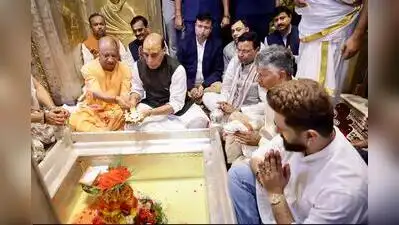
Varanasi: Stating that a good leader dreams big for the country, while a great leader turns those dreams into reality, defence minister Rajnath Singh on Tuesday credited Prime Minister Narendra Modi with transforming India’s security, governance and global standing.
Singh said PM Modi had already completed 25 years in public service, including 13 years as Gujarat chief minister and 12 years as Prime Minister, and still had decades of service ahead. “For the past 25 years, he has been discharging the responsibilities of constitutional offices with utmost dedication and will continue to serve the country for decades to come. Because govts were either inactive or focused on saving their chairs, targeting previous regimes, Singh said that before 2014, India often missed major opportunities. He said products such as Banarasi silk and Chandauli’s black rice had gained global recognition due to Modi’s efforts.
“PM Modi’s legacy will be remembered for freeing the country from Naxalism, removing Article 370 in Jammu & Kashmir, lifting crores of people out of poverty, increasing women’s participation in Parliament and giving wings to the aspirations of the youth,” he said while addressing a function organised here to mark the launch of the Seva Sankalp campaign on Modi’s 76th birthday. Only half an innings has been played so far,” he said. Recalling the 2001 earthquake in Gujarat, Singh said Modi, as the then chief minister, transformed the state’s development trajectory afterwards “from a test match into a one-day cricket match”. Singh said Modi’s approach was to see solutions and possibilities where others saw problems. Praising Modi’s push for local products, Singh said the PM presents Indian-made items to world leaders, citing the example of a Gulabi Meenakari peacock brooch from Varanasi gifted to then US President Joe Biden.
He cited the ‘One District One Product’ initiative as an example of efforts to take local crafts, agricultural products and traditional industries to national and international markets. Referring to the semiconductor sector, he alleged that a leading global chip manufacturer had wanted to set up a factory in India, but was denied permission twice by the then Congress govt, costing the country jobs and industrial growth.