
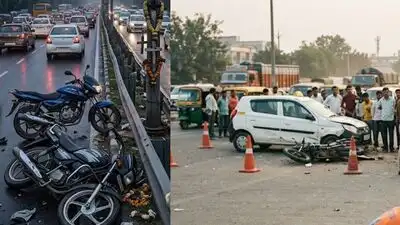
Ghaziabad has reported an average of three road accidents daily in recent months, leading to numerous victims (AI image)
Gautam Budh Nagar’s PM- Rahat claims are higher at 149 in the same period (an average of 30 a month), but still very low when compared to accident numbers. The city recorded 577 road accidents between Jan and July this year, claiming 450 lives, according to traffic police data. Police have up to 24 hours to respond through eDAR, or up to 48 hours in cases the hospital administrator classifies as life-threatening.
Once the victim reaches a designated hospital, treatment begins under the approved health benefit packages. The hospital generates a treatment ID on the NHA’s transaction management system (TMS) and sends details to police through the electronic detailed accident report (eDAR) system for verification. Police authentication runs alongside treatment and is not a prerequisite for the hospital to begin emergency care. The system creates a digital trail from the accident report through admission, treatment, police verification, claim processing and payment.
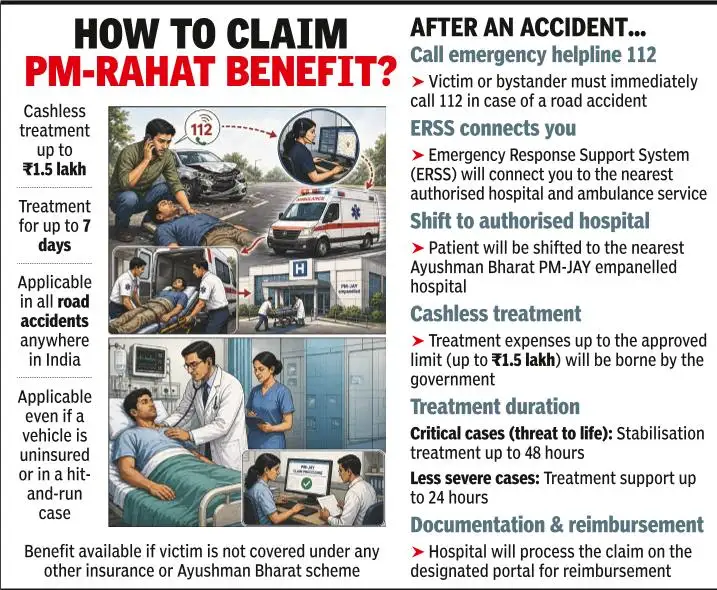
The number points to shortcomings in the way the scheme is being implemented, which assume significance after a 24-year-old accident victim who was seriously injured in a road accident and could not get the level of treatment he needed at a PM Rahat empanelled hospital, died this week. It covers motor vehicle accidents on any category of road and provides cashless treatment of up to Rs 1.5 lakh per road accident victim for a maximum of seven days from the date of the accident. Much of the network of hospitals under the scheme has been built around hospitals already empanelled under Ayushman Bharat scheme.According to official guidelines from Ministry of Road Transport & Highways, the scheme automatically covers all 36,112 hospitals empanelled under Ayushman Bharat (PM-JAY). In Noida, the scheme covers all 61 hospitals under Ayushman Bharat, while in Ghaziabad 86 are empanelled. A victim, bystander or family member can call Dial 112, the emergency response support system, which is integrated with PM-Rahat and can provide ambulance assistance and information about the nearest empanelled hospital.
The process is designed so that victims or their families do not have to arrange money or complete lengthy paperwork before emergency treatment begins. The objective is to ensure that once an accident is reported, the responding personnel can quickly identify the nearest PM-Rahat empanelled hospital and arrange for the victim to be shifted there without losing critical time,” Rakesh said.
Health officials told TOI all AB-PMJAY empanelled hospitals that provide the requisite trauma, polytrauma and stabilisation services in compliance with National Health Authority (NHA) guidelines are deemed designated hospitals for cashless road accident treatment. Ghaziabad health department nodal officer (road safety) Dr Pankaj Rakesh said the district had taken steps to ensure that police and emergency responders know where designated hospitals are located. Police responding to an accident can also access the list of empanelled hospitals. “Information about the empanelled hospitals, including their names and locations, has been shared with police officials at different levels, including police stations and senior officers, as well as emergency service providers.
A victim can become ineligible for the scheme’s benefits if hospitalisation occurs more than 24 hours after an accident. Police also need to authenticate claims within 24 hours for non-life-threatening injuries and 48 hours for life-threatening ones, or an application can be rejected. 679 claims were approved since rollout, while 168 were rejected after no response was received from the police within the prescribed timelines, according to health department data. Another 40 life-threatening cases were found ineligible under the scheme by the police. Under the scheme, cases classified as life-threatening by the hospital administration remain eligible for treatment until the case is rejected by the police through e-DAR or until 48 hours have elapsed, whichever is earlier.
Strict digital deadlines, patchy hospital empanelment and early-stage system gaps have affected the uptake and reimbursement process. Some empanelled hospitals still turn patients away or demand upfront payment, fearing delayed reimbursement.