

Bhadohi carpet
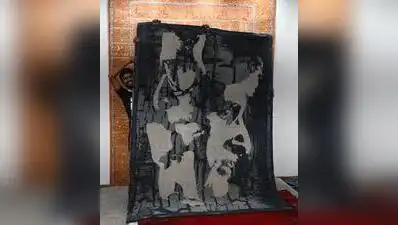
Sanjay Kumar Bhadohi carpet Sanjay Kumar Bhadohi carpet Bhadohi : Ready for the morning shift at the wheels of the door-to-door garbage collection tipper in Khamaria nagar panchayat (town council) of Bhadohi, Sanjay Kumar Saroj has been making Rs 12,000 a month for the past two years. About 20-km away from Khamaria, Andy Caughey, chief executive officer of Wool Impact, an advocacy organisation from New Zealand, remained busy explaining the value proposition of the crossbred woollen fibre for carpet manufacturers at the India Carpet Expo. Caughey was in Bhadohi for four days (Oct 4-7) to participate in the 50th edition of handmade carpet exhibitions that is set up annually with the support of the ministry of textiles . Providing a platform through which the wide variety of Indian carpets are showcased before global buyers, in the 50th edition of the exhibition intermediaries and buyers from 65 different countries participated in the four-day event. Saroj, a 26-year-old native of Bhadohi, and Caughey, 63-year-old New Zealand corporate executive, seem to be chasing the same purpose – to strengthen their positions as value chain integrators in the carpet business. From Oct 20, the two countries (India and New Zealand) would enter a new international trade era whereby no tariff would be levied over the wool that is imported from New Zealand. As the second largest international wool buyer, India accounts for 20% of our business,” says Caughey. As the largest handmade carpet producer in the world, more than 90% of the woollen rugs and carpets prepared in the country are exported. Value of handmade carpet exports during 2024 and 2025 amounted to Rs 12,250 crore and Rs 12,562 crore, respectively, according to trade intelligence and analytics portal (maintained by department of commerce). Till July this year, foreign carpet trade amounting to Rs 7,783 crore had been registered. Bhadohi gains significance here since the eastern UP district single-handedly accounted for 31% and 30% of the international carpet trade that took place in 2024 and 2025 in India. This year too, 26% of the global orders have been handled by Bhadohi exporters till July. Home to more than 30 lakh native and migrant weavers, the Bhadohi-Mirzapur carpet cluster earned the Geographical Identification tag certification in 2010. Carpet weaving in the belt dates to over 400 years, having flourished immensely under the Mughal era. For the first time, attempts were made to come up with estimates of household income generated through production of traditional handicrafts through the 1961 census (survey of handicrafts and household industries). THE GT ROAD CONNECTION Broadly known as national highway 19, the erstwhile Grand Trunk Road served as a major artery for trade and commerce facilitating movement of convoys between Delhi and Kolkata via Agra, Kanpur, Prayagraj and Varanasi in the ancient and medieval periods. In Bhadohi, the Prayagraj-Varanasi section of the NH 19 intersects another national highway (Mirzapur to Jaunpur) at Aurai crossing, a major junction for the local population. The United States has been the strongest trading partner for the country, traditionally accounting for 60% of the business in 2024, 2025 and 2026, followed by Germany and the United Kingdom.
I have seen some youths upgrading their lifestyle by generating additional income through online marketplaces,” he says. “Estimated to be in the range of 3,500,” the survey report mentions, “weavers in the region got used to working on the looms during the Mughal rule”. Aspiring to strike success, Sanjay bought a smartphone recently with his savings to double up as an entrepreneur for a few hours every night. “New Zealand is the largest exporter of premium wool. We had put up a stall at the exhibition to build stronger relationships with Bhadohi-based manufacturers and other industry stakeholders. Aware about the vast opportunities, Sanjay, like Andy, is desperate to woo buyers for his products. The immediate challenge before him is to learn the algorithm that could pop up his products on the screens of e-commerce users in the United States, Germany and the United Kingdom. “I have been struggling to find buyers from the US and Europe for the past fortnight. With the help of some AI tools, I would be able to improve my prospects if I continue to devote time over Etsy and eBay. I am unable to come up with catchy titles, descriptions and keywords as a rug seller. It will take some time to get there. INDIA’S CARPET CITY Still considered as backward, the rise of Bhadohi as India’s Carpet City as an industrial powerhouse globally has not happened overnight. A part of Varanasi district at that time, Bhadohi was cited as the centre of woollen carpet manufacturing. Unlike age-old traditional knitting that requires working with a single yarn, weaving requires working on two separate yarns through looms. Quality of the fabric, uniqueness of the design, dyeing process, shearing, binding, finishing touches and detailing are other important factors that play a crucial role to determine the final price. Over the past decade, hand-tufted carpets have become the largest produced commodity in local factories. Unlike hand-knotted carpets that could take months to get final before being shipped, hand-tufted carpets are easier to make. Requiring less turnaround time, foreign buyers started preferring the affordable hand-tufted carpets over the steeply priced hand-knotted ones. Instead of waiting for several months, the tufted carpets reach their destination within a few weeks. Handwoven is another category of carpets which is also popular. Similarly, floor coverings, rugs, durries, mats, cushion covers are also abundantly available. The cold parts of the United States, UK, Europe have consistent demand for Bhadohi carpets. Whereas the dry, humid and hot climatic conditions offer limited scope for creating a demand for woollen carpet domestically.
A document compiled by the Varanasi regional industries office in June 2009 offers some clarity. 75, the oldest carpet designer from Ghosia locality of Khamaria, some people fell sick during the movement of a convoy between Agra and eastern India during Akbar’s rule, according to Mushtaq Ahmed. Spread over 6 acres in Salimpur village, Ahmad’s factory is busy handling orders from South Korea where average temperatures plummet to sub-zero briefly during peak winters.
“According to stories we have heard from our forefathers, residents from Madhosingh hosted individuals who had fallen sick in their houses. That is how our ancestors learned to work on handlooms,” says Ahmed, who pulled out from the business after design, software and applications became available freely for online users. Without being a major seat of power during the Mughal empire, how did Bhadohi manage to emerge as the hub of hand-knotted carpets, is a question that haunts everyone. The document specifies Madhosingh, a village situated between Bhadohi and Mirzapur alongside Grand Trunk Road as the place where hand-knotted carpet weaving originated. Moved by their care and affection, the ones who knew weaving prepared some items as a goodwill gesture. Some of them settled down in Madhosingh, Khamaria and Aurai. Madhosingh, Khamaria, Ghosia and more than two dozen villages situated within a range of 5km from GT road gradually shaped up as the grooming centres encouraging institutionalised production of hand-knotted woollen carpets. The first company and factory through which carpet trade was formalised was set up in Khamaria in the early 1920s. KEY TAKEAWAYS FROM EXPO West Asia crisis, tariff war, hostile atmosphere regulating international trade, lack of willingness among local youths to learn weaving, support of govt on some fronts, were some concerns that were taken up casually during discussions among stakeholders. With rerouting of transit via the Cape of Good Hope instead of Suez Canal, increased freight costs and delayed shipments muted growth prospects. Managing director of Textico and member of the Carpet Export Promotion Council, Imtiaz Ahmad, is a third-generation carpet businessman from Bhadohi.
Despite being a strong manufacturing hub, Bhadohi is at 58th spot among the 75 districts of UP in per-capita income. Average annual income of an individual in Uttar Pradesh during 2024-25 amounted to almost Rs 1.1 lakh whereas a resident of Bhadohi was able to earn only Rs 72,000, reveals the data compiled by the directorate of economics and statistics. Having a lower personal income (65% of the usual UP wide earnings) even after being the global hub of manufacturing, shows earnings are not being evenly distributed in the carpet city. Data suggests, the carpet industry continues to drive the economic growth of Bhadohi since manufacturing accounts for 15.26% of the economy in the carpet city. In contrast, manufacturing contributes only 7.81% in Varanasi and 6.56% in Mirzapur. Offering an average income of Rs 54,781, its third immediate neighbour Jaunpur is far behind. A weaver earns Rs 500 to Rs 1,200 a day, according to the intricacy of design and duration of work. The price of such carpets (12ft x 9ft) could be in the range of Rs 8,000 to Rs 4 lakh. Entry level carpets have 60 knots per square inch while the most premium ones could have more than 290 knots in a square inch.
You Can Also Check: Gold Rate in Lucknow | Silver Rate in Lucknow | Bank Holidays in Lucknow | Public Holidays in Lucknow | Lucknow AQI | Weather in Lucknow | Petrol Price in Lucknow | Diesel Price in Lucknow | CNG Price in Lucknow | LPG Price in Lucknow Stay updated with the latest Lucknow news.
In the latest expo, I personally reached out to luxury home decor brand players from Hong Kong, Egypt and South Korea to explore opportunities,” says Ahmad, adding that his maternal grandmother who is settled in Madhosingh village taught family members to work on handlooms. We have also compiled some suggestions for improving international market access through friendly trade policy initiatives,” he says. We have also requested the UP govt to accord industry status to carpet industry and formulate a dedicated policy,” says Ahmad. Exporters make the highest profit in the value chain followed by the middlemen,” said advocate Amit Barnawal from Bhajaipur locality while explaining the dynamics. Over the generations thousands of weavers have managed to upgrade their skill set to either become a trader or exporter,” he says. My peers have been continuously researching over the internet to learn more about the consumer behaviour in American and European countries,” says Sanjay.
A high school dropout, Sanjay has been struggling to navigate Etsy, a popular online marketplace for buyers from the United States and Europe who are on the lookout for specialised handcrafted home decor items. In villages of Khamaria, youths are increasingly active around midnight over global online ecommerce platforms such as Etsy, eBay and Amazon with a common objective – finding international buyers willing to pay a premium for hand-knotted Bhadohi carpets. “We insulate our trade by exploring new regions which have remained untapped so far. “We have requested the central govt to revive the inland container depot at Madhosingh and establish a multimodal logistics hub in Bhadohi to bring down the logistics cost. “Intervention is also requested to strengthen skill development and artisan welfare programmes for long-term stability. INCOME DISPARITY WIDENING As is the case with major manufacturing towns across the world, adjacent the high walls protecting the private residential enclaves of exporters, stand unfinished houses of carpet weavers alongside the station road. Yet Bhadohi’s per-capita income remains significantly below its two immediate neighbours (Varanasi and Mirzapur). “Weavers are at the bottom of the pyramid sitting under the traders (or the middlemen). Exporters are at the top. Only a limited value is offered to weavers for manual labour. “I would like to add here that weavers remain largely insulated from market fluctuations and risks. Exporters suffer heavy losses during turbulent times. KNOTS, CRAFT & COMMERCE With wool being the primary raw material, the carpet industry is completely export oriented. Hand-knotted woollen carpets continue to provide the highest premium while hand-tufted carpets are at the top in terms of volume. Tufted carpets are prepared with hand-guided machines, with artisans punching loops on the spread-out fabric as per pre-designed patterns. Hand-knotted carpet artisans work manually to weave the knots to create patterns. Just as the quality of a high-definition photograph is decided by the total count of pixels per inch, the price of a hand-knotted carpet is determined by the number of knots that have been woven within a square inch of the fabric. In Bhadohi, the value of hand-knotted items are calculated as per the density of the knots and rates are offered to weavers as per the size of the final piece in square metres. The price points could vary as per the density. “That is why Etsy and eBay are getting extremely popular with youths here. Download the TOI App.