
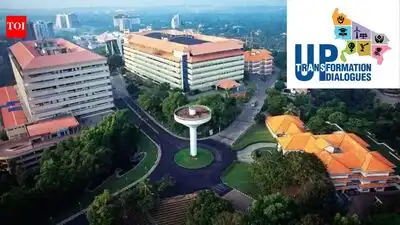
Kanpur Dehat is experiencing development through improved infrastructure including roads and healthcare facilities.
Spread over about 3,021 sq km with 979 villages, Kanpur Dehat remains predominantly rural. In 2026, the state government reviewed a comprehensive action plan for accelerating road and bridge projects in the Kanpur region, including Kanpur Dehat, with emphasis on timely completion and quality construction. The district’s administrative network itself comprises six tehsils and 10 development blocks, with 640 Gram Sabhas, creating a substantial institutional framework for taking development programmes to the grassroots. Investment proposals worth around ₹17,000 crore were reported from Kanpur Dehat, covering sectors such as food processing, logistics, warehousing, electric vehicles and manufacturing. The proposed industrial zones are part of a broader plan covering 11 districts and 872 industrial plots.
Its transformation, therefore, cannot be measured only through large industrial projects. Kanpur Dehat, once largely identified with its agrarian economy and its proximity to the industrial powerhouse of Kanpur, is undergoing a gradual but significant transformation under the Yogi Adityanath government. Over the last nine years, the district has witnessed a development approach that combines better infrastructure, healthcare expansion, drinking-water access, industrial promotion, rural welfare and employment generation. It is equally visible in the expansion of basic amenities and the creation of new economic opportunities for farmers, entrepreneurs, women and youth. From connectivity deficit to better infrastructure Connectivity has emerged as one of the important pillars of Kanpur Dehat’s development. The government’s emphasis has been on improving roads, bridges and links between villages, markets and urban centres. Improved road connectivity is particularly important for a district whose economy is closely linked with agriculture and small industries. Better roads reduce transportation costs, help farmers reach markets faster and make rural areas more attractive for investment. A major transformation in healthcare The district also emerged as a significant destination during the Global Investors Summit process. The proposals included commitments from several companies, while the district administration positioned industrialisation as a route to large-scale employment generation. More recently, the state has planned new MSME-focused industrial estates in several districts, including Kanpur Dehat, as part of a wider effort to expand manufacturing and create local employment. An additional step has been the conversion of unused government land in the Akbarpur area into an industrial zone, creating space for new enterprises. ODOP gives local enterprise a new identity The One District One Product (ODOP) programme has provided another avenue for strengthening traditional and local manufacturing. Kanpur Dehat’s identified ODOP product is aluminium utensils, providing an institutional framework for supporting local producers and connecting district-level production with larger markets. The broader ODOP model seeks to revive local industries, support artisans and entrepreneurs, facilitate finance and technology and connect traditional products to national and international markets. For Kanpur Dehat, the challenge and opportunity now lie in upgrading traditional manufacturing with modern designs, better packaging, digital marketing, quality certification and access to organised markets. Housing, sanitation and welfare The transformation is also visible in household-level welfare. Housing schemes such as Pradhan Mantri Awas Yojana-Gramin, sanitation initiatives and other social-security programmes have sought to improve living conditions in rural areas. District-level data systems now track implementation of housing, sanitation, drinking water and other rural development schemes, creating greater scope for monitoring outcomes. The government’s focus on women-led self-help groups, financial inclusion and livelihood programmes is also changing the nature of rural economic participation. Instead of remaining solely beneficiaries of welfare programmes, rural women are increasingly being positioned as entrepreneurs, service providers and participants in local economic activity. A new development trajectory The transformation of Kanpur Dehat is ultimately about connecting rural development with economic opportunity. Roads connect villages with markets; tap water improves household quality of life; the medical college strengthens healthcare; ODOP supports local enterprise; and industrial parks and investment proposals create possibilities for non-farm employment. The district still faces challenges, including the need to convert investment proposals into operational units, expand employment opportunities, strengthen urban infrastructure and deepen value addition in agriculture and traditional industries. But the direction is increasingly clear.
The medical college was established under the broader objective of the “One District, One Medical College” approach, aimed at taking tertiary healthcare and medical education closer to populations that previously depended heavily on larger cities. Perhaps one of the most visible changes has been in medical education and healthcare infrastructure. The establishment and operationalisation of the Autonomous State Medical College, Kanpur Dehat, at Kumbhi, Akbarpur, represents a major shift in the district’s healthcare landscape. The institution is now conducting MBBS admissions and has continued expanding academic and clinical activities. Its associated district hospital has also been involved in diagnostic, emergency, community-health and family-adoption programmes. For residents, this means that specialised healthcare and medical education are increasingly available within the district itself rather than requiring every patient to travel to Kanpur city. Drinking water reaches the village doorstep The Jal Jeevan Mission has added another important dimension to rural transformation. Household tap-water connections are being expanded through new and retrofitted water-supply schemes across Kanpur Dehat. Government data for individual schemes illustrates the progress. For instance, the Maitha water-supply scheme shows villages and households receiving functional household tap connections, with some villages reporting very high levels of coverage. The significance goes beyond infrastructure. For rural households, especially women, reliable piped water can reduce the time and physical effort traditionally spent fetching water. It also supports better hygiene, sanitation and household health. Agriculture remains the economic backbone Kanpur Dehat’s transformation is not about replacing agriculture but about creating more value around it. The district has substantial potential in agriculture-based industries and food processing. An official export action plan identifies hundreds of MSME units in agro-based and food-product categories, alongside employment in several manufacturing segments. This creates an opportunity to move from a primarily production-oriented rural economy towards one based on processing, packaging, storage, logistics and value addition. Government schemes supporting farmers, rural housing, sanitation, self-employment and women’s self-help groups have further widened the economic base of rural families. The convergence of such programmes is gradually creating a stronger rural consumption and enterprise ecosystem. Industrialisation and the MSME push One of the most important aspects of Kanpur Dehat’s emerging economic identity is its growing industrial potential. The Yogi government’s PLEDGE initiative identified Kanpur Dehat among the districts where private industrial parks could be developed. The state has positioned such parks as instruments for attracting investment, creating jobs and strengthening local industrial infrastructure.
You Can Also Check: Gold Rate in Lucknow | Silver Rate in Lucknow | Bank Holidays in Lucknow | Public Holidays in Lucknow | Lucknow AQI | Weather in Lucknow | Petrol Price in Lucknow | Diesel Price in Lucknow | CNG Price in Lucknow | LPG Price in Lucknow Stay updated with the latest Lucknow news. Under the Yogi government, Kanpur Dehat is moving beyond its traditional image as a rural extension of Kanpur and emerging as a district with its own development and industrial identity. The next phase will depend on how effectively infrastructure, investment, skills, agriculture and entrepreneurship are integrated. If this convergence continues, Kanpur Dehat can become an important growth centre in central Uttar Pradesh—where rural prosperity and industrial development reinforce each other. Download the TOI App.