
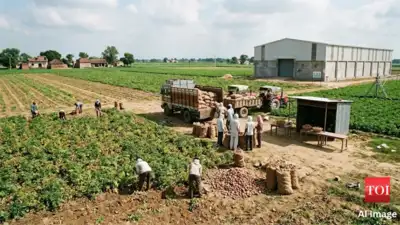
Market access remains central to the profitability of potato cultivation. (AI Image)
Because it has a relatively short crop cycle and can provide farmers with an important source of seasonal income, potato cultivation is particularly important. Farrukhabad has emerged as one of Uttar Pradesh’s important centres of potato cultivation, with the crop playing a major role in the district’s rural economy. The fertile alluvial soil of the Ganga basin, favourable winter temperatures, irrigation facilities and the availability of cold-storage infrastructure have together created an ecosystem in which potato cultivation has become a major source of income for farmers. Over the years, the crop has also generated employment and business opportunities in transportation, storage, grading, trading and food processing. The transformation of Farrukhabad’s potato economy is increasingly being shaped not merely by higher production but also by the Yogi Adityanath government’s efforts to address the challenges farmers face after harvesting. Under the state government, the focus has expanded to include irrigation, better agricultural infrastructure, market access, price stability, mechanisation and diversification of the rural economy. Farrukhabad’s potato belt has developed a network of farmers, commission agents, traders, transporters and cold-storage operators around the crop. This interconnected value chain makes potatoes much more than a field crop; they are an important component of the district’s rural economy. One of the defining features of Farrukhabad’s potato economy is the presence of cold-storage facilities. Potatoes can be stored for several months, allowing farmers and traders to avoid distress sales immediately after harvest. The cold-chain ecosystem has consequently become an important part of the district’s agricultural infrastructure.
Farrukhabad’s potato economy is therefore evolving from traditional cultivation towards more integrated agricultural development. The scheme’s current provisions and eligibility requirements should be confirmed before publication. You Can Also Check: Gold Rate in Lucknow | Silver Rate in Lucknow | Bank Holidays in Lucknow | Public Holidays in Lucknow | Lucknow AQI | Weather in Lucknow | Petrol Price in Lucknow | Diesel Price in Lucknow | CNG Price in Lucknow | LPG Price in Lucknow Stay updated with the latest Lucknow news.
The potato economy, however, is also exposed to fluctuations in production and prices. When acreage and yields rise sharply, the market can experience a glut, pushing prices down. Farmers who have invested heavily in seeds, fertilisers, irrigation, labour and harvesting can consequently face significant losses. Recognising this challenge, the Uttar Pradesh government has been strengthening interventions aimed at providing farmers with greater protection against extreme price volatility. Among the initiatives cited for potato growers is the Bhamashah Bhav Sthirta Kosh, or Price Stabilisation Fund. The scheme is described as being designed to provide assistance to potato farmers when market prices fall sharply below viable levels. Its current status, eligibility criteria and applicability to Farrukhabad’s potato growers should be verified before publication. For a crop such as potatoes, where production cycles can result in temporary oversupply, price stabilisation is crucial. Such schemes seek to reduce the income shock caused by a sudden collapse in market prices and provide farmers with greater confidence to continue cultivation. The broader objective is to ensure that increased production does not automatically translate into increased vulnerability. By creating a mechanism for support during periods of severe price decline, the government aims to make potato cultivation more economically sustainable. Irrigation is another critical component of the potato economy. Potatoes require timely irrigation at different stages of crop development, making reliable water availability essential for productivity. Government programmes promoting irrigation infrastructure, micro-irrigation, solar-powered agricultural pumps and the efficient use of water can help farmers reduce their dependence on uncertain water sources. The expansion of irrigation facilities can also enable farmers to make more efficient use of available land and improve crop productivity. The PM-KUSUM programme, which includes support for solar-powered agricultural pumps, is particularly relevant for farmers seeking reliable irrigation while reducing dependence on conventional energy sources. Such interventions can lower operational costs over time and contribute to more resilient agricultural production. For Farrukhabad, improving the potato economy also means strengthening what happens after the crop leaves the field. Cold storage, sorting, grading, packaging, transportation and processing are all essential components of a modern potato value chain. Government policies supporting agricultural infrastructure and food processing can help farmers move beyond selling raw produce to participating in higher-value activities. Processing potatoes into products such as chips, fries, flakes and other processed foods creates additional economic opportunities and reduces excessive dependence on fresh-market prices. This transition from a production-centric model to a value-chain model can generate employment beyond farming and create new opportunities for rural youth and entrepreneurs. Market access remains central to the profitability of potato cultivation. Government efforts to modernise agricultural markets, promote digital transactions and improve transparency in agricultural trade can help farmers access a wider pool of buyers. The expansion of digital agricultural platforms and institutional procurement mechanisms can further improve price discovery. Farmer Producer Organisations (FPOs) and collective marketing can also increase the bargaining power of small and marginal farmers by allowing them to aggregate produce, negotiate better prices and reduce transaction costs. For a district such as Farrukhabad, strengthening these linkages can help connect local potato production with markets across Uttar Pradesh and other parts of the country. The state government’s initiatives in mandis also seek to strengthen the relationship between farmers and regulated agricultural markets. Under the Mukhyamantri Krishak Uphaar Yojana, farmers undertaking eligible transactions in mandis can receive incentives through coupons, with opportunities to win agricultural equipment through periodic lucky draws. they may benefit farmers in major potato-producing districts by encouraging formal mandi transactions and increasing their engagement with organised agricultural markets While such initiatives are not limited to potato growers. The future of Farrukhabad’s potato economy lies in diversification. Greater processing capacity, modern cold chains, improved packaging, scientific storage and stronger Farmer Producer Organisations can help transform the district from a major potato-producing area into a more comprehensive potato value-chain hub. There is also scope to encourage startups and small enterprises in areas such as potato processing, seed production, logistics, packaging and farm machinery services. Such enterprises can create local employment while increasing the share of value retained within the district. The government’s broader agricultural strategy, combining irrigation, infrastructure, farmer support, digital services, market reforms and price-risk management, provides a framework for this transformation. The crop already supports numerous farming households and a wider ecosystem of traders, cold-storage operators, transporters and workers. The challenge now is to make this ecosystem more resilient and profitable. With better storage, stronger market linkages, processing facilities and farmer-oriented schemes, Farrukhabad can build on its natural advantages and develop a more diversified potato economy. The objective is not simply to grow more potatoes but to ensure that every stage, from seed and cultivation to storage, processing and marketing, creates greater economic value for farmers. For Farrukhabad, the next chapter of the potato economy could be defined by a shift from volume to value, from seasonal cultivation to an integrated value chain, and from price vulnerability to greater income resilience. Download the TOI App.
The Yogi government’s interventions, particularly those aimed at price stabilisation, irrigation, agricultural infrastructure, market access and post-harvest management, are intended to address the vulnerabilities that have historically affected potato growers.