
Humidity and good hair days don’t always go together. Hair that feels smooth indoors can turn frizzy within minutes of stepping outside. managing hair in humid weather starts with understanding what happens to the hair fibre While serums and styling products offer temporary solutions. Navneet Misra, Founder & CEO, Xtovia, shares insights on how to manage hair in humid weather.
In humid conditions, water molecules enter the hair fibre and influence the temporary hydrogen bonds and ionic interactions that contribute to its shape and structure. As moisture levels change, these interactions can be disrupted and re-established, causing hair to swell, lose its styling and become frizzy, particularly when it is damaged. The hair’s outer layer consists of overlapping scales. When these scales lie flat and overlap evenly, hair feels smoother and its surface appears more uniform. When the cuticle becomes lifted, eroded or uneven, hair feels rough, tangles more easily and becomes harder to manage. A compromised cuticle can also allow moisture to move in and out more readily, amplifying humidity’s effects. Hair masks have traditionally been treated as intensive conditioners. But deeper conditioning and targeted damage repair are not the same thing. Hair damage can affect multiple levels, from the cuticle and its protective lipid layer to internal structures responsible for strength. A product may smooth the surface without addressing underlying damage. Think of the cuticle as a road with potholes. A temporary coating may make the road appear smoother, but the potholes underneath remain. Similarly, conventional conditioning ingredients can improve slip and softness without necessarily repairing the cuticle. Very few specialised repair masks contain targeted actives designed to improve cuticle alignment, restore surface uniformity and replenish the protective lipid layer. By reducing surface roughness and supporting a more consistent barrier, suitable formulations may help limit unwanted moisture exchange, leaving hair smoother, shinier and easier to manage in humidity.
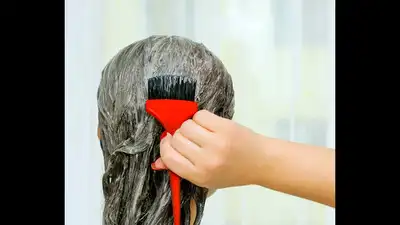
Certain repair masks are also designed for use before shampooing, on dry or slightly damp hair. This gives repair ingredients the intended application conditions and sufficient contact time to work effectively. It’s practical, too: you can get on with your morning rather than waiting in the shower with dripping wet hair. Not every hair mask needs to be a repair treatment. If hair is generally healthy but prone to frizz, a conditioning mask that improves smoothness and manageability may be sufficient. For hair exposed to frequent heat styling, colouring or chemical treatments, specialised repair formulations may offer additional benefits. The key is to distinguish between temporary surface smoothness and treatments intended to improve the condition of damaged hair. Healthy hair comes from consistently choosing products and routines suited to its needs. Rather than fighting frizz every morning, focus on improving hair condition over time so it becomes more manageable and less reactive to humidity. You use AI every day. Now get your AI Quotient. Take the AIQ test Get the latest Lifestyle News and more. Download the TOI app.