
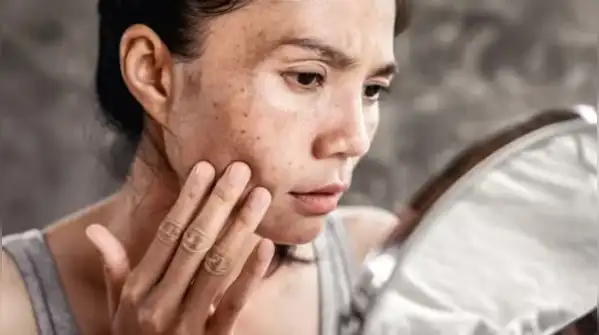
The week after Diwali brings its own kind of skin complaints. Itchy eyelids are common. Cheeks can also start stinging from a moisturiser someone has used for two years without a problem. People whose eczema had stayed quiet for months come back with a flare and usually want to know what they did wrong. Most of the time, they did nothing wrong. The air has a lot to do with it, along with everything else the festive season throws at the skin. Crackers get most of the blame, though a good share comes from stubble smoke drifting in from the fields, plus traffic fumes, road dust, and that cold, still November air in which none of it really moves. Most of the worry this season is about the lungs, understandably. The skin, meanwhile, spends the whole day sitting in that same air without any kind of filter.
Last year, in the days after the festival, Delhi’s fine particle levels went past three times what they had been before it.

Itching that won’t settle, or that gets worse at night, tends to come first.
A pack that says “anti-pollution” on the front doesn’t really say much. For those who already have a prescribed eczema cream or medicine, the advice is to carry on with it as the doctor said and to make sure it’s at hand before the festivities get going. Dermatologists often describe the skin barrier as a brick wall, with skin cells for bricks and lipids like ceramides doing the job of the cement. Filaggrin, a protein, is part of how the wall gets built; as it breaks down, it gives rise to the natural moisturising factors that hold water in the skin. Fine particles from polluted air appear to interfere with all of these processes, and on top of that, they bring oxidative stress and inflammation along. What follows is something of a loop. Once the barrier is weaker, irritants get through more easily, the skin gets more inflamed, and the barrier ends up weaker than it was to begin with. Still, pollution is seldom the only reason a flare happens. Studies do link air pollution with eczema in children and in adults, but the results are not uniform, and there isn’t much research looking at Diwali specifically. It makes more sense to think of it as a strong trigger on skin that was already vulnerable. That is why looking after the barrier this time of year matters so much. In eczema, the barrier is often weak to start with. Sometimes the issue comes down to changes in the filaggrin gene. Either way, there’s less reserve. Then the festive season piles on. The air gets drier just as people start taking hotter showers. Diwali cleaning means dust and cleaning chemicals everywhere. There are new synthetic outfits, imitation jewellery that may have nickel in it, perfume, late nights, and a fair amount of stress. When it all comes in the same week, even a product that has always suited someone can begin to burn. The skin may feel tight or dry or start flaking even though the moisturiser hasn’t changed. Products that are normally fine can start to sting. Rough patches show up on the eyelids, the neck and the hands, or in the folds of the elbows and knees. One thing that gets missed often: on Indian skin, eczema usually looks dark brown, purple or grey and not bright red. So a change in colour counts too. A few things shouldn’t be left to settle on their own: oozing or yellow crusting, for instance, painful blisters, fever, a rash that seems to be spreading by the day, or itching so bad that sleep goes for a toss. These need a dermatologist sooner rather than later. None of this needs an elaborate routine. A gentle one that can actually be kept up every day works better. Washing up after coming in from outside is the first step, and lukewarm water with a mild, fragrance-free cleanser does the job well enough. Scrubs and peel-off masks can wait, as can rubbing ubtan in hard, at least till the skin isn’t irritated any more. Moisturiser goes on while the skin is still damp, within a few minutes of bathing, and once more at night. Ceramides, glycerin and petrolatum are good to see on the label, preferably in something fragrance-free. A properly formulated barrier moisturiser is the better thing to buy first. If the skin is stinging, retinoids and exfoliating acids are worth stopping for a bit, and once things have calmed down, they can come back in, one product at a time. Staying in when the smoke is at its worst, with the windows shut, cuts down a fair bit of contact. Soft cotton worn under the heavier festive fabrics helps too. And once back home, changing out of those clothes and washing up gets rid of most of what has settled on the skin over the evening. The over-the-counter tubes that mix a steroid with an antifungal or antibiotic are another matter; they can cover up what’s actually going on with the skin and end up making it worse.
Before Diwali Night
In eczema, the barrier often has less reserve to begin with, so that can be enough to bring back a flare that had been quiet for months. Because the air is drier, baths are hotter, there’s dust from all the cleaning, and new clothes, late nights, and all of it land in the same week, it’s rarely just the pollution, though,. Nobody can do much about the AQI on Diwali night. What can be managed is how much strain the skin is under that week. Protecting the barrier early helps. So does a simple routine, and getting advice before a small flare becomes a big one. For better understanding, we approached Dr Ridhima Arora, dermatologist, MBBS, MD (Dermatology & VD), who explained, “After Diwali, the fine particles in the air seem to disturb the skin barrier and set off inflammation. What helps is keeping things gentle and fragrance-free, putting moisturiser on while the skin is still damp and giving strong actives a short break; over-the-counter steroid combination creams are better left alone. Oozing, yellow crusting, blisters, fever or itching that is disturbing sleep should be shown to a dermatologist early.”