
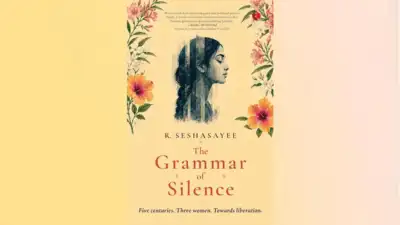
The Grammar of Silence by R. Seshasayee
In The Grammar of Silence, by R. Seshasayee attempts something both ambitious and difficult: to tell five centuries of Tamil social history through the intimate lives of three women. Set largely around the Kaveri delta and Thanjavur, the novel moves across dramatically different historical periods, following Dharma, Vinodhini and Mary as they negotiate caste, faith, patriarchy, social convention and, eventually, modernity.takes on the formidable task of tracing five centuries of Tamil social history through the lives of three women – Dharma, Vinodhini and Mary. Set largely in the Kaveri delta around Thanjavur, the novel moves through changing political regimes and social worlds, while examining the structures that continue to shape women’s lives. The novel’s premise is straightforward, but its execution is layered. Political regimes change, kingdoms rise and fall, colonial power arrives, and India eventually becomes independent. Yet the structures governing women’s lives prove considerably more stubborn. Seshasayee’s central observation is that oppression does not necessarily disappear; it changes its vocabulary. Dharma’s story, set in the seventeenth century, is particularly strikingperhaps the most affecting. Married as a child and subsequently left in an ambiguous state between wife and widow, she gradually begins to questioning the customs governingthat determine almost every aspect of her existence. Her resistance is quiet rather than dramatic, rebellion is rarely theatrical. Instead, it emerginges through small acts of curiosity, learning and a growing refusal to accept every rule at face value. unwillingness to accept every rule at face valuerefusal. Her bondrelationship with Muthu, a girl from a lower caste, also brings questions of caste, privilege and inherited social divisions into the narrative. who once lived on the land now occupied by Dharma’s family, becomes one of the book’s most telling explorations of caste and inherited privilege. The historical canvas subsequently expands. The novel brings together music, temple culture, food, language, religion and changing political authority, making the world of its characters unusually tactile. Seshasayee is particularly effective when he allows social history to emerge from ordinary details rather than exposition. A river, a kitchen, a manuscript, a song or a ritual often reveals more about hierarchy than a page of historical explanation.As the story moves across centuries, kingdoms change, colonial rule arrives, and India becomes independent. Yet patriarchy remains more persistent than political power. The novel’s central idea is that oppression may alter its form and vocabulary without disappearing entirely. One of its pleasures is the textured world Seshasayee creates. Food, clothing, temple traditions, religion, language, music and the landscape of the Thanjavur region are woven naturally into the narrative. Carnatic music and Tamil cultural references add depth, while the Kaveri delta feels almost like a character in its own right. The novel’s expansive historical sweep, however, can occasionally make the narrative feel heavy. The movement between periods demands patience, and its reflective passages may seem slow to readers seeking a more tightly plotted historical fiction
There is also considerable pleasure in the book’s language. The prose is attentive to landscape and sound, frequently drawing on Tamil cultural references and Carnatic music. At its best, this creates a strong sense of place; the Kaveri delta becomes more than a backdrop, almost another character in the narrative. The novel is not without its weight. Its historical breadth and large cast occasionally make the narrative feel expansive to the point of excess. The transitions between periods require patience, and readers looking for a tightly plotted historical novel may find its reflective passages slow. Yet the book’s ambition is also its defining quality. The Grammar of Silence is less interested in presenting history as a sequence of events than in asking what survives beneath those events. Its three women inhabit different centuries, communities and circumstances, but their questions about agency, dignity and freedom repeatedly intersect. By the time the narrative reaches contemporary India, the nature of silence has changed, even if the need to challenge it has not. That continuity gives the novel its strongest resonance. It leaves the reader with an uncomfortable but enduring question: when social structures change, how much of the old grammar do we continue to speak? Still, the breadth is central to the book’s appeal. By placing three women in different eras and circumstances, Seshasayee connects their struggles for dignity, agency and freedom. The result is a thoughtful exploration of what changes with time, and what stubbornly remains across generations, cultures and time itself. You use AI every day. Now get your AI Quotient. Take the AIQ test Get the latest Lifestyle News and more. Download the TOI app.