
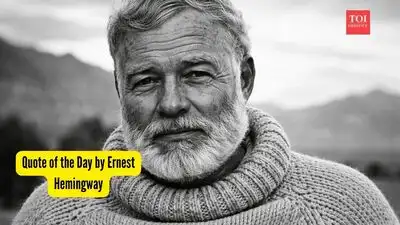
Ernest Hemingway
Hemingway was born on July 21, 1899, in Oak Park, Illinois, into a fairly comfortable family. He volunteered for the Red Cross in 1918 as an ambulance driver in Italy. His style is evident in his first novel, The Sun Also Rises (1926), which tells of the wanderings of expatriates through Europe after the First World War. He followed it up with A Farewell to Arms (1929), which was based heavily on his experiences in wartime Italy. The Sea and the Writer Hemingway’s interest in courage, endurance and nature perhaps found its purest expression in The Old Man and the Sea (1952). Hemingway won the Pulitzer Prize for Fiction in 1953 for the work. Hemingway died in Ketchum, Idaho, on July 2, 1961, at the age of 61.
Because of something extraordinarily hard to do: he made simplicity powerful, and more than six decades after his death, his writing continues to be read. The experience also helped shape his identity as part of the Lost Generation, a group of writers who came of age during or after World War I and often struggled with the disillusionment of the time. A year later he won the Nobel Prize for Literature.
The newspaper’s style guide, it is said, called for short sentences, clear language and energetic writing – the principles that would later become central to Hemingway’s literary style. He never explained unnecessarily, he relied on readers to understand what his characters were feeling from what they did and said. This was the “iceberg theory” or the theory of omission. What Hemingway says hints at something more profound than the idea that intelligent people are condemned to unhappiness.
Ernest Hemingway was among the most influential American writers of the 20th century. His novels and short stories changed modern literature with their lean prose, understated emotion and memorable characters. He wrote about war, love, masculinity, courage, adventure, loss and death, but behind the apparent simplicity of his language lay a profoundly complex understanding of human nature. His father, Clarence Hemingway, was a physician; his mother, Grace Hall Hemingway, a musician and teacher. From a young age, Hemingway took an interest in writing and the outdoors. After graduating from high school, he went to work for the Kansas City Star as a reporter. His life was transformed during World War I. He was seriously wounded by mortar fire while in Italy and spent months recovering. His wartime experience had a powerful influence on his writing, particularly his understanding of courage, trauma and disillusionment. After the war Hemingway moved to Paris and joined a remarkable community of writers and artists. He moved among characters like Gertrude Stein, F. Scott Fitzgerald, Ezra Pound and James Joyce. These were significant years for the development of his writing. In his memoir A Moveable Feast, published later, Hemingway described the writers and artists he met in Paris. A new way to write Hemingway’s style was perhaps his greatest contribution.In a time when literary prose could be elaborate and very descriptive, Hemingway often did the reverse. His sentences were short, pointed, economical. The idea was that a writer should only show a small part of the story directly, But like an iceberg, most of its meaning lies below the surface. A character might say very little about grief or fear or love, but the reader can feel huge emotion behind it. It made Hemingway’s writing seem deceptively simple. His sentences were often easy to read, but his stories were not necessarily easy to comprehend. The book caught the restlessness and disillusionment of a generation. The novel blended love and war and looked at the destructive effects of violence. This novella is about Santiago, an old Cuban fisherman who has a hard time catching a giant marlin. The story is simple on the surface, but underneath is a meditation on dignity, perseverance, ageing, defeat and human resilience. His mastery of narrative art and his impact on the contemporary style were cited by the Nobel committee. Hemingway’s life of adventure Hemingway wasn’t just a writer of adventure, he was a seeker of it. He travelled extensively, lived in Europe and Cuba, went on African safaris, fished, hunted and witnessed major historical events. He was also a correspondent in the Spanish Civil War and later covered World War II.His experiences found their way into his fiction over and over. He was interested in bullfighting, big-game hunting and deep-sea fishing, and those subjects turned up in all his writing. His public image, too, was fused inextricably with ideas of toughness, of independence and of masculine courage. Yet Hemingway’s sense of courage was more complex than his outsized persona might suggest. His characters often find themselves in circumstances beyond their own control. They are not necessarily strong in winning but in holding to dignity in the face of suffering or defeat. His Influence on Literature Hemingway revolutionised the way generations of writers wrote prose. His influence is seen in journalism, fiction, screenwriting and popular storytelling. Writers learned from his ability to create powerful scenes without over-explaining. But his impact was not confined to literature. The image of Hemingway the traveller, fisherman, war correspondent and writer entered popular culture. But his legacy has its critics too. His personal life was also complicated, with multiple marriages, physical injuries, alcoholism, and periods of serious emotional distress. His stories remind us that courage is not always a grand thing, that pain can hide behind everyday talk, and that a person’s character is often shown not in what they say, but in what they do when life is hard. Perhaps Hemingway’s greatest lesson as a writer is in the space between his words, in what he deliberately left unsaid. Quote of the Day One of the most iconic lines of Ernest Hemingway are, ” Happiness in intelligent people is the rarest thing I know. He is speaking of the link between intelligence, consciousness and happiness.
The intelligent man often sees more than what is immediately before him. They see contradictions, uncertainty, injustice, disappointment and complexity of human behaviour. The problem may be ignored by someone, but the analytical mind keeps asking Why? What if… What is this? That constant awareness can make simple happiness hard to come by.
In that sense, Hemingway’s line is less about the curse of intelligence and more about the difficulty in finding peace when your mind just won’t stop thinking. An intelligent person can also overthink. They may not just have a moment, they may analyse a moment. They may not accept a situation, but rather question it. Rather than enjoying their success, they may start to think about what could go wrong next. They seldom have a completely still mind. Then there is the issue of expectations. The more you know about the world, the more clearly you can see the gap between what the world is and what it could be. They may come to understand that relationships aren’t perfect, success is fleeting and life has its share of suffering along with the joy. Such a consciousness can make happiness appear fragile. But the point of Hemingway’s observation is that “intelligent people cannot be happy. It implies that maybe happiness requires something that intelligence alone cannot provide: the ability to stop thinking and experience life. Sometimes happiness is about things that do not need an intellectual solution, a conversation with someone we love, sunlight on a quiet morning, a meal shared with friends, music, nature or just being present. Here is an interesting paradox: the intelligence that brings awareness of the problems of life can also bring understanding of what really matters. Or perhaps that’s the quote’s real meaning. Happiness does not necessarily mean the absence of hard thoughts. It’s that ability to live with those thoughts, without letting them destroy every moment of joy. Looking for trusted parenting advice? Follow TOI Parenting Circle on Instagram for expert guidance, relatable stories, and practical tips delivered every day.