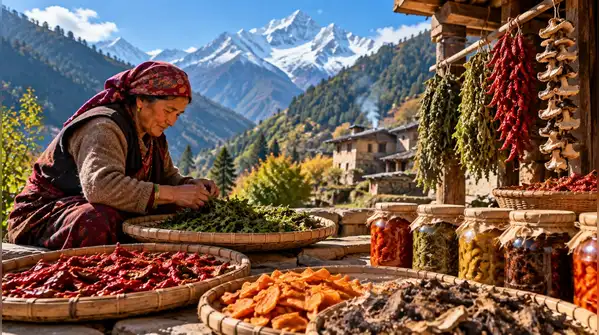
Research published in ScienceDirect on Himalayan food systems describes these practices as traditional “biopreservation,” using drying, fermentation, and other natural processes to extend the life of perishable foods. Long before refrigerators and freezers reached remote mountain settlements, Himalayan communities had already developed ways to make seasonal food last through months of cold, snow and difficult travel. The techniques are remarkably practical. Vegetables are fermented and dried, fruit is exposed to the intense mountain sun, meat is smoked or dried, and some crops are stored in cool rooms or underground. In places where winter can sharply limit fresh produce, preservation is not simply a culinary tradition. It is a way of planning for the season ahead.
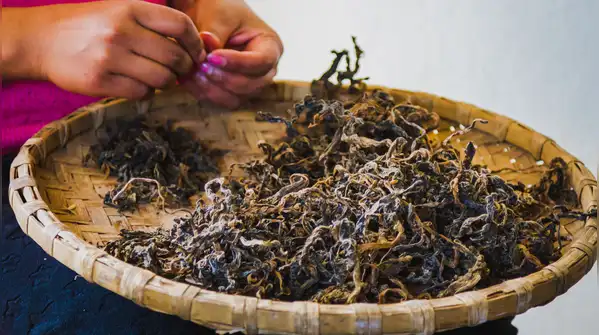
They are then crushed and tightly packed into a container, where they undergo natural lactic-acid fermentation for roughly 15 to 22 days. A 2025 review of Himalayan food systems notes traditional sun-dried meat preparations among communities including the Bhotiya and Changpa, allowing meat to be kept through periods when fresh food is harder to access. Because it fits the landscape exceptionally well, still, traditional preservation survives.
Research describes sun-drying as one of the oldest preservation techniques used for apricots in Ladakh, with modern solar dryers later introduced to improve hygiene and efficiency. In parts of Sikkim, Nepal and the eastern Himalayas, surplus leafy vegetables can be transformed into gundruk, a fermented vegetable product. Fresh mustard, radish, cabbage and other leaves are first wilted, traditionally for around one to two days. Once fermented, the vegetables are removed and sun-dried for several days. The result is a lightweight, intensely sour dried food that can be stored at room temperature and later rehydrated for soups, curries and pickles. Research has found lactic-acid bacteria in traditionally produced gundruk, helping explain how fermentation contributes to its preservation. Far to the west, the cold, arid landscapes of Ladakh offer a different preservation strategy. The region receives abundant sunshine despite its freezing winters, making sun-drying particularly useful. Apricots are among the best-known examples. They are dried traditionally as whole fruits or after removing the stone, producing a food that can be kept for consumption during winter. Other fruits and vegetables, including apples, cabbage, cauliflower, radish and turnip, have also traditionally been dried or stored for winter use. Research into traditional vegetable storage in Ladakh has documented practices such as keeping cabbage in house basements and storing root and tuber crops under conditions suited to the cold-arid environment. Preservation also extends to animal foods. Research on Himalayan food systems documents communities using smoking and sun-drying to extend the storage life of meat when fresh supplies are difficult to obtain. Among some high-altitude communities, pieces of meat are hung to dry during the cold season, while smoking can reduce moisture and microbial activity and add another layer of preservation. What makes these methods fascinating is that the preservation equipment is often remarkably simple: sunlight, air, bamboo, straw, earthen pots, underground pits and the naturally cold environment. Modern refrigeration, improved transport and packaged foods have changed household diets in many mountain communities. A refrigerator needs electricity and regular access to power. A mountain household can dry a harvest when the sun is strong, ferment vegetables when they are abundant and store the finished food for the months when the fields produce little. In that sense, Himalayan food preservation is less about surviving without a modern kitchen and more about understanding the mountain itself as part of the kitchen.
But these practices are not interchangeable across the Himalayas, nor are they necessarily used in every village today.