
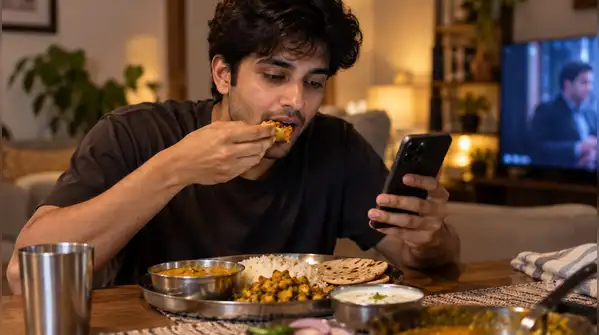
Eating dinner while watching a show, scrolling through reels or catching up on YouTube has become almost second nature. For many people, the screen is simply part of the meal. But psychology research suggests that this seemingly harmless habit may change the way we experience food, particularly when it comes to recognising one of the body’s most important signals during a meal. That signal is satiety, or the feeling that you have had enough to eat. When attention is divided between food and a screen, the brain has fewer resources available to notice what is happening during the meal. This does not mean that everyone who eats in front of a screen will overeat, but research suggests that distraction can make it harder to accurately register fullness and may influence how much people eat later.

These cues help determine when a meal should end. A 2006 study published in the British Journal of Nutrition explored what happens when attention is diverted during eating. In a 2014 study published in Appetite on ScienceDirect, researchers compared women eating a snack while watching television with eating without television. Another study published in Appetite in 2013 involved 81 participants who ate under different conditions, including watching television, social interaction and eating alone.
Those who were distracted experienced smaller changes in reported fullness and desire to eat compared with those who ate without the distraction. Eating is not just about putting food into the body. The brain constantly receives information about taste, smell, texture, stomach fullness and satisfaction. Researchers asked participants to eat Jaffa Cakes either while playing a computer game or without the distraction. The findings suggested that distraction could reduce sensitivity to the cues that normally help signal the end of a meal. In simple terms, you may still become physically full, but you may not be paying as much attention to the feeling. Television has received particular attention in research on distracted eating. Participants consumed more food while watching TV. The researchers also found that television viewing appeared to reduce sensitivity to internal hunger and fullness cues. Those watching television consumed more than participants in some of the other conditions. Researchers suggested that distraction may alter the relationship between how much food is eaten and how the desire to eat changes during the meal.

It may also affect your next meal
One of the more interesting findings is that the effect may not stop when you finish eating. A 2013 systematic review and meta-analysis published in the American Journal of Clinical Nutrition examined 24 studies involving attention, memory and distraction during eating. Instead of consciously noticing each bite and how satisfying the meal feels, you may rely more on external cues, such as finishing what is on the plate or reaching the end of an episode. Interestingly, a 2024 experiment published in National Library of Medicine, involving 137 participants tested whether a brief mindfulness exercise could reduce food consumption while people watched television. Researchers found that distracted eating was associated with greater immediate food intake, while the effect on later food intake was even larger. The review suggested that paying less attention to a meal could affect memory of what was eaten, potentially influencing eating later. That distinction matters: the research does not suggest that watching something while eating automatically makes you overeat every time. The effect appears to depend on the type of distraction and the circumstances surrounding the meal. One explanation is attention. When your eyes and thoughts are focused on a dramatic scene, an interesting conversation or an endless social-media feed, eating can become more automatic. it did not significantly reduce the amount of food they consumed during the distracted eating task Although the exercise increased participants’ state mindfulness. The authors noted that more research is needed to understand exactly when and how mindful attention influences eating. Not necessarily. The research is more useful as a reminder to notice how you eat rather than as a reason to treat screens as forbidden during meals. Try occasionally eating without a screen and paying attention to the food, your pace and how your body feels as the meal progresses. You may find that the biggest difference is not the food itself, but how clearly you notice the moment when your body is telling you that you have had enough. And that quiet signal can be surprisingly easy to miss when your attention is somewhere else.