
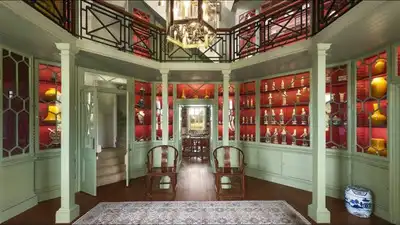
King George III’s 1769 observatory in Richmond has been transformed into a private four-bedroom home and is now listed for £18 million. Its royal history, original astronomical cupola, scientific legacy and nearly seven acres of grounds make it one of London’s most unusual historic residences (Image credit: Alex Winship)
Built for King George III in 1769, the Grade I-listed building has gone from royal observatory to scientific workplace and, eventually, a private family residence. Now, more than 250 years after it was built, the unusual property has entered the London luxury market for £18 million, roughly $24 million (approx 230 Crore Rupees). The building was completed in 1769, just in time for the Transit of Venus on June 3, when the king, Queen Charlotte and members of the scientific team gathered to observe the rare astronomical event. The house also has a library with about 6,000 books, adding another layer to its unusually scholarly character. The Meteorological Office operated there until 1980. Among the scientists connected with the observatory was James Martin Stagg, who became superintendent in 1939. The observatory’s latest transformation began after planning permission was granted in 2014 to convert it into a single-family residence. The main restoration was completed in 2018 under owner and property developer Robbie Brothers. The roughly 7,300-square-foot home sits on nearly seven acres of Old Deer Park. Planning permission also allows a further 10,000 square feet of development, including additional living space, staff accommodation and underground parking for up to 17 cars. At £18 million, the real luxury may not be the size.
There are historic homes, and then there are homes where the history is almost impossible to hide. The King’s Observatory in Richmond, London, belongs firmly to the second category. George III commissioned architect Sir William Chambers to create the observatory in Richmond’s Old Deer Park. The building was not simply a royal curiosity. George III had a serious interest in science, and the observatory also became a place for studying instruments, clocks and natural-history specimens. The feature that makes the house especially memorable sits above it. Its astronomical cupola retains its rotating mechanism, allowing a telescope to be aligned with different parts of the sky. The observatory describes it as the oldest surviving telescope cupola of its kind. Inside, two striking octagonal rooms retain original Georgian glass cabinets associated with the king’s scientific collections. The building later became known as Kew Observatory and developed an important scientific life of its own. During the Second World War, Stagg served as chief meteorological adviser to General Eisenhower. His weather forecasts played an important role in decisions surrounding the timing of the D-Day invasion. That chapter has also returned to popular attention through the film Pressure, in which Andrew Scott portrays Stagg. The interiors do not try to erase the building’s past. Georgian architecture sits beside Chinese-inspired decoration, including hand-painted silk wallpaper based on an 18th-century view of Canton. Asian art and ceramics collected by Brothers add another personal layer. The result feels less like a polished modern mansion and more like a house that has accumulated stories over centuries. The grounds include a private drive, ornamental lake, Portland stone boathouse and landscaping associated with the area’s historic landscape. It is the chance to live inside a building whose original purpose was wonderfully simple: to look up at the sky. Disclaimer: Property prices, historical details and restoration information are based on publicly available sources and the property’s current listing. You use AI every day. Now get your AI Quotient. Take the AIQ test Get the latest Lifestyle News and more. Download the TOI app.