
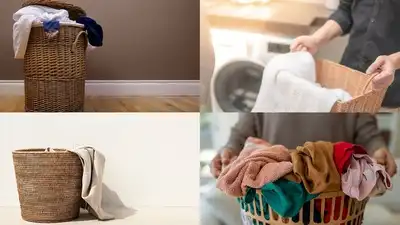
There’s a decent chance you’ve got a stack of old newspapers, a few metres of leftover fabric, or a sturdy cardboard box sitting around the house right now, and all of it could easily become a genuinely useful laundry basket instead of just more clutter. Buying one from the store isn’t expensive, sure, but there’s something satisfying about making your own, especially when it costs next to nothing and can be shaped exactly to fit the corner of your room you’ve been meaning to tidy up. Here’s a simple way to put one together using materials you probably already have lying around.
For the sturdiest, most practical version, a large cardboard box works as the base structure, paired with some fabric to line and cover it, a bit of strong glue or a hot glue gun, and scissors. If you’d rather skip cardboard altogether, an old wicker basket, a large plastic bin, or even a wooden crate can serve as the base instead, in which case you’re mainly just adding a fabric liner rather than building the structure from scratch. Either way, the process stays fairly forgiving, so there’s no need to be precise with measurements down to the centimetre. If you’re using a cardboard box, cut it down to the height you want your basket to be, keeping in mind that laundry baskets generally work best somewhere between knee and waist height for easy use.
Reinforce the bottom corners with extra tape or a bit of cardboard glued in layers, since this is usually where a cardboard basket weakens first under the weight of clothes. If you’re repurposing an old basket or crate instead, this step is as simple as giving it a quick wipe down and checking there’s nothing structurally wobbly before moving on. Measure your base’s height and the circumference or perimeter, adding a few extra centimetres on each side for seam allowance and a bit of overlap at the top edge. Cotton, canvas, or any sturdy, washable fabric works well here, since laundry baskets inevitably pick up a bit of dust and lint over time and you’ll want something you can wipe down or toss in the wash occasionally. If you want a double-sided look, with a different pattern inside versus outside, cut two pieces of fabric to the same dimensions rather than just one. Starting from one corner, glue or stitch the fabric around the outside of your base, smoothing it as you go to avoid bunching or wrinkles, and folding the extra fabric at the top edge over and securing it neatly for a clean finish. If you’re lining the inside as well, repeat the same process inside the basket, tucking and securing the fabric at the bottom and top edges so it lies flat rather than sagging loosely. Hot glue tends to work faster for this than sewing, though a needle and thread gives a slightly more polished, durable result if you’re willing to put in the extra time. A laundry basket without handles gets old fast, especially once it’s full, so this step genuinely matters. Two sturdy strips of the same fabric, folded over a few times and stitched or glued securely to opposite sides of the basket, work well as simple handles. For something that holds up better under weight, rope or thick cotton cord threaded through small reinforced holes near the top edge makes for a slightly more durable grip, particularly useful if you’re planning to carry a fairly full basket up and down stairs regularly. If you’ve used cardboard, a final layer of fabric or even a thin sheet of plywood glued to the bottom can help the basket hold its shape over time and handle the weight of a full laundry load without sagging or collapsing. This step is optional for sturdier bases like an old wicker basket or crate, but for anything cardboard-based, it genuinely extends how long the basket stays functional rather than slowly caving in after a few weeks of regular use. Disclaimer:
This article is intended for general informational and craft purposes only. Durability and results may vary depending on the materials used and the weight of laundry the basket is expected to hold. For heavier daily use, consider reinforcing the base further or opting for a sturdier starting material like an existing basket or crate. You use AI every day. Now get your AI Quotient. Take the AIQ test Get the latest Lifestyle News and more. Download the TOI app.