
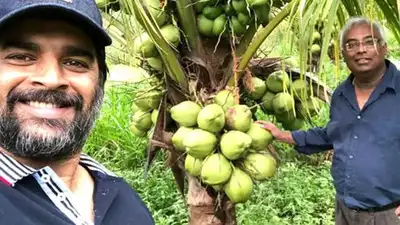
R. Madhavan and his cousin Subayogan spent about three and a half years turning dry land near Palani into a coconut plantation. Their experiment combined traditional, organic and modern methods, while the return of earthworms and birds offered signs of a recovering ecosystem. (Credit: Instagram)
The project dates back to around 2020, when Madhavan and Subayogan worked on the land near Palani. A dry patch of land near Palani in Tamil Nadu became an unlikely farming experiment for actor R. Madhavan and his cousin Subayogan. What began as an attempt to make nearly barren land productive eventually became a coconut plantation. The transformation reportedly took about three and a half years and relied on a mix of traditional, organic and modern farming practices. Madhavan later described it as one of the most satisfying projects he had undertaken. The plantation was developed with pure dwarf, non-hybrid coconut varieties, known for their sweet water and aroma. But the bigger achievement was not simply growing coconut trees. It was getting the exhausted land to support life again. Madhavan has spoken about using the right mulch and learning how soil, water and other elements worked together. The project reportedly combined indigenous practices with modern and organic farming methods. That approach has a strong scientific basis. The Tamil Nadu Agricultural University (TNAU) recommends mulching coconut basins with coconut husks, leaves or coir pith to conserve soil moisture and reduce evaporation.
Water management made a difference
That detail should therefore not be presented as a standard farming recommendation. Because it did not happen in a few months, madhavan’s plantation story is interesting. Disclaimer: This article is based on publicly reported details about Madhavan’s farming project and official agricultural guidance.
Reports said earthworms and native birds returned to the area, suggesting that the land had begun supporting a wider living system again. Water is one of the biggest challenges in coconut cultivation, particularly on dry land. TNAU notes that drip irrigation can improve water-use efficiency, while mulching helps retain moisture around the palms. The project also involved maintaining the farm’s well. Madhavan specifically recalled learning about putting the right fish in the well, although publicly available reports do not provide enough technical detail to establish exactly which fish species or why they were selected. The plantation eventually showed signs that went beyond healthy coconut trees. Seedlings were also reportedly made available to nearby farmers at below-market prices, giving the project a community angle. The most useful lesson is perhaps the simplest one: restoring land is a process, not a makeover. Better soil, careful water use, organic matter and time can work together. Madhavan’s project offers a personal example of that principle, while the agricultural science behind mulching and moisture conservation shows why some of those practices can work beyond a celebrity farm. Looking for trusted parenting advice? Follow TOI Parenting Circle on Instagram for expert guidance, relatable stories, and practical tips delivered every day.
It took roughly three and a half years of work before the barren-looking land became a productive coconut farm.