
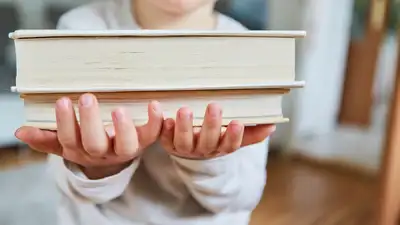
File photo
8 Oct 2026 | 14:25 But these moments may be doing more than interrupting a parent’s routine. A study published in Infancy in 2026, titled Growing Communicators: A Fine-Grained Analysis of Toddlers’ Communicative Intentions , examined natural interactions involving 47 toddlers aged 13, 18 and 23 months. They found that expressive interactions, which included sharing interest, attention or emotion, accounted for 49.9% of the recorded interactions. Requesting an object or action accounted for 40%. A recent study on infant-caregiver interactions, published in 2026, examined eight parent-infant pairs over six months, beginning when the babies were seven or eight months old. The 2026 Infancy study also identified information-seeking and help-seeking as part of toddlers’ early communication. These interactions accounted for 8.3% of the recorded events. A 2013 study published in PLOS ONE found that one-year-olds and their parents frequently coordinated their visual attention through their hands and eyes while playing with toys.
Because they cannot open it, hand over a broken toy or show their parent an unfamiliar object they have discovered, a toddler might bring a closed container. Because children do not need to know the words ‘What is this?’ or ‘Can you help me?’ to communicate that they need an answer, this is particularly interesting. A toddler walks into the room carrying a spoon. A few minutes later, they return with a sock, a plastic lid or a toy that has been lying unnoticed in a corner. Sometimes, they place the object in their parent’s hand. At other times, they simply hold it up, wait for a reaction or leave it beside them before running off to find something else. For adults, these little exchanges can seem amusing, confusing or even pointless. Why bring a parent something that has no apparent use? And why do children sometimes seem so determined to show them the most ordinary things around the house? In early childhood, bringing, showing and sharing objects can be important ways of initiating social interaction. Before children can fully explain what they are thinking, they often use objects, gestures and actions to communicate their interests, invite attention and connect with the people around them. Research on early communication and joint attention offers some interesting explanations for this behaviour. One of the most interesting explanations comes from a concept in developmental psychology called joint attention. It refers to the ability of a child and another person to focus on the same object or event while being aware that they are sharing that experience. File photo For instance, when a child picks up a colourful leaf, brings it to their mother and looks at her face, they may not necessarily want anything from her. They might simply want her to notice what has caught their attention. This is an important part of early social development. Children gradually learn that experiences can be shared, not just objects possessed. Bringing something to a parent can become a way of saying, ‘Look at what I found’ or ‘I want you to see this too. Researchers analysed how children used gestures such as reaching, pointing, giving and holding out objects to communicate with caregivers. The findings suggest that toddlers’ gestures are not simply attempts to get something. Many are ways of initiating social exchanges. A child bringing a spoon, a toy car or a household object may also be inviting a parent to become part of an activity. Think about a toddler who places a ball in their father’s hand and waits. When the father rolls it back, the child repeats the action. What began as giving an object can turn into a game of passing, throwing or taking turns. These seemingly simple exchanges help children understand reciprocity: the idea that communication involves taking turns and responding to another person. Researchers observed how infants initiated object-related activities during play. One recurring pattern involved babies throwing an object and caregivers returning it, gradually creating a throwing-and-passing sequence. The researchers identified elements of intentional communication in these exchanges. it offers an interesting insight into how everyday interactions with objects can become early forms of social communication Although the study involved a small sample. Not every object brought to a parent is an invitation to play. Sometimes, a child may be confused about how something works or may want an adult to help them solve a problem. Developmental research recognises that children’s gestures can serve different purposes, including requesting assistance, seeking information and drawing attention to something they do not understand. Their actions can do some of that work before their spoken language develops. There is another reason children may repeatedly bring seemingly ordinary household objects to their parents: they are exploring how the world works. A kitchen spoon, a measuring cup, a remote control or a piece of fabric may look unremarkable to an adult. But a young child is still discovering what objects are called, how they feel, what they do and how they relate to other things. When a child brings an object to a parent, the adult’s response can add another layer to this exploration. For example, if a toddler brings a wooden spoon, a parent might say, ‘That’s a spoon. We use it to stir the dal. The child hears the object’s name and connects it with an action and a familiar household activity. Research on early communication suggests that shared attention around objects creates opportunities for language learning. They did not always need to look directly at each other’s faces to attend to the same object. This highlights how ordinary object-based interactions can support shared learning. The next time your toddler walks towards you carrying a spoon, an old sock or something you cannot immediately identify, pause for a moment before putting it away. They may not be bringing you something useful. They may be bringing you into something that has caught their attention. And sometimes, that is the whole point. You use AI every day. Now get your AI Quotient. Take the AIQ test Get the latest Lifestyle News and more. Download the TOI app.

Your reaction may influence what they do next
Because it has helped them connect with someone, they may repeat the action. File photo Children also learn from how adults respond to their attempts to communicate. If a child brings a random object and the parent looks at it, names it, asks a question or plays along, the child receives a response to their social bid. This does not mean parents must turn every object into a teaching opportunity. Sometimes, simply acknowledging the child is enough. A parent could say, ‘Oh, you brought me your little cup!’ or ‘Where did you find this? If the child seems interested, the conversation can continue. If they move away, there is no need to insist. The important thing is to notice what accompanies the gesture. Is the child looking at your face? Are they waiting for you to respond? Are they trying to make you hold the object, open it or play with it? These details can help parents understand what the child might be communicating. A child bringing random household objects is not automatically displaying a particular psychological trait or sending a hidden message. Sometimes, they are simply curious, carrying something they like or repeating an action they find enjoyable. The meaning can also change depending on the child’s age, language development, temperament and the situation. However, parents need not dismiss these small gestures as meaningless interruptions. For a child who is still learning to express thoughts through words, an object can become a conversation starter, an invitation to play or a request for help.