
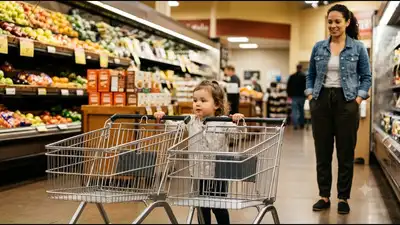
A toddler’s attempt to manage two shopping carts has drawn praise online for her patience and persistence. The video shared by Deddeh Howard offers a parenting lesson on encouraging independence, supporting early problem-solving and knowing when to help without taking over. (AI-generated representational Image)
5 Oct 2026 | 12:06 Instead of immediately stepping in, her mother allows her to try. Sometimes, a small moment in an ordinary place can offer a meaningful lesson in parenting. A video shared by Deddeh Howard shows her young daughter at a grocery store, trying to manage two shopping carts with her little hands. What makes the clip special is not just the child’s determination, but the patience required to let her work things out. The toddler keeps trying until she finds a way, turning a simple shopping trip into a lesson about independence, patience and the importance of giving children room to learn. The little girl, who was almost two when the video was recorded, struggles to carry both shopping carts. The task looks simple to an adult, but it is clearly difficult for someone so young. The child keeps working on the problem, adjusting her approach until she manages it. Howard posed a question alongside the video: “The hardest part was not stepping in to help her. Would you have helped or let her figure it out? That question captures a familiar parenting dilemma. Watching a child struggle can be uncomfortable, even when the problem is harmless. Helping feels natural, but sometimes a little time and space can teach more than an immediate solution. Children learn through everyday experiences, not just through instructions from adults. Figuring out how to hold a toy, put on shoes or move an object helps them understand what works and what does not. In the grocery store, the toddler gets an opportunity to observe the problem, experiment and adjust her actions. These small experiences can support early problem-solving skills and confidence. However, one short video cannot establish a child’s overall intelligence or future abilities. Its value lies in showing how an ordinary challenge can become a learning opportunity.
They might ask, “What else could you try?” or demonstrate one step before allowing the child to continue. Her reflection, “How did we get here so fast?”, adds another layer to the moment. Parents can offer a little guidance without taking over. Safety matters, too. Adults should step in when an activity involves heavy objects, sharp edges, traffic or other risks. In a public place such as a grocery store, supervision remains essential. The most useful approach is often a balance: stay close enough to help, but leave room for the child to make manageable decisions. Howard later shared that her daughter is now three and is about to become a big sister. Childhood moves quickly, and everyday scenes can become precious memories. The grocery store video is a reminder that learning does not always need a formal activity or a carefully planned lesson. It can happen while getting dressed, tidying toys or helping with simple household tasks. Children do not need adults to turn every difficulty into a test. They need opportunities to explore, make mistakes and try again, with someone nearby when help is needed. Sometimes, the most meaningful support a parent can offer is not doing the task for a child, but giving them the confidence to attempt it themselves. Watch the video here: Disclaimer: This article discusses general parenting principles through a social media video. You use AI every day. Now get your AI Quotient. Take the AIQ test Get the latest Lifestyle News and more. Download the TOI app.
The comment section was filled with people cheering for the toddler. Many praised her persistence, focus and patience, while others admitted they would have struggled not to intervene. This reaction highlights something parents often overlook: giving children time also requires adults to manage their own impatience. A task that takes an adult seconds may take a toddler several attempts. Rushing to finish it for them can save time, but it can also remove an opportunity to practise. That does not mean parents should never help. The goal is to recognise when a child can safely keep trying and when assistance is necessary. Encouraging independence is not the same as expecting children to manage everything without support. Young children still need supervision, reassurance and clear boundaries.