
Image: https://x.com/themodernhp
Tucked away in the pine-covered hills of Chail in Himachal Pradesh, at nearly 7,000 feet, there’s a temple that doesn’t appear in most guidebooks and barely shows up on Google Maps. By the time reporting on the temple caught up with his story, construction costs were estimated at close to Rs 15 lakh, a figure built up gradually over years rather than through any single donation or grant. “I dreamt of a temple in 1980 and there has been no looking back since. Till now, nearly Rs 15 lakh has been spent on its construction, which is still in process,” he told TOI. By 2018, Bhushan had been working on the temple for 38 uninterrupted years, and even then, the structure wasn’t complete.
Because one man, back in 1980, had a dream about Lord Shiva so vivid he couldn’t shake it off, and decided the only reasonable response was to spend the rest of his life building what he’d seen, it exists.
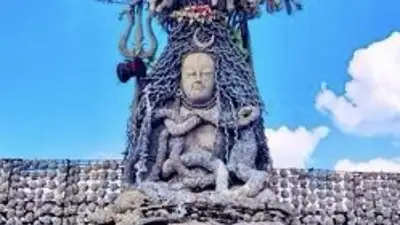
He saw Lord Shiva in a vision, commanding and tranquil, and unlike most dreams that dissolve within hours, this one stayed etched in his mind with unusual clarity, according to accounts of his story. He took it as a calling rather than a passing thought, and in 1980, he began turning his own ancestral land into what would eventually become the Stoned Kumbh Shiv Temple, sometimes called simply “Temple in My Dream,” a phrase spelled out in twisted metal wire that still sits atop the structure today. No architect designed it. No trust funded it from the start. As per reports, Satya Bhushan was a local resident of Chail with no formal training in architecture or sculpture when the dream came. Bhushan had no technical training, no professional guidance, and by most accounts, no formal plan beyond the image locked in his memory. He built the temple using materials suited to whatever he could source locally, cement, tin sheets, ropes, and slated rock, shaping intricate carvings and an underground cave structure entirely by hand. It was one man, on a hillside, turning a private spiritual experience into something permanent, stone by stone, for decades. For a long time, almost nobody outside Chail knew the temple existed. Bhushan reportedly funded the earliest phase of construction from his own personal savings, treating it as a private devotion rather than a public project. But as locals began visiting and word slowly spread, the community started pitching in, both with labour and small financial contributions. I had already learnt making clay sculptures and wooden carvings during my school days, and was, in fact, made fun of by my classmates for studying Arts in school. My dream gave me a platform and inspired me to make this temple. Initially, only locals knew about it. They came here and contributed funds. He kept refining details, adding carvings, and expanding sections of the site well into his sixties. Visitors who’ve spoken to him describe someone who never asked for help outright, never installed a donation box, and never treated the project as a business, even as social media and travel content slowly turned his quiet hillside shrine into a minor tourist curiosity. There’s something quietly striking about a man spending the better part of four decades on a single structure with no institutional backing, no formal training, and no guarantee anyone would ever notice. And by most accounts, as of the last available reporting, he was still out there, adding one more piece to something that started as nothing more than a dream he refused to let go of. Looking for trusted parenting advice? Follow TOI Parenting Circle on Instagram for expert guidance, relatable stories, and practical tips delivered every day.