
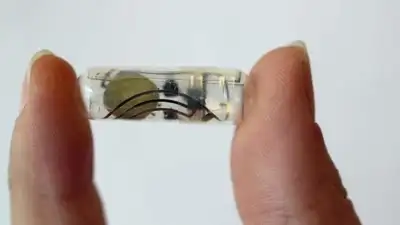
Edible batteries? Scientists develop swallowable paper battery to power medical devices inside the body.
What happened when the scientists tested it?
With just a couple of days of use in pigs, they showed they could boost ghrelin, which is a hormone that drives hunger, by 50%.
This new “edible” battery, which really belongs in the “bioresorbable” category, marks a leap for temporary medical electronics meant to live inside the body. That’s the frontier called “electroceuticals,” where tiny zaps and pulses could become new medical treatments, especially for digestive problems. Imagine swallowing a battery and not being worried about it! And now picture this: a future where the battery inside a swallowable medical device doesn’t just power the gadget; it actually dissolves away when it’s done, so there’s nothing left to dig out or retrieve. That’s what MIT scientists and their partners are inching toward with a kind of battery that looks like paper, generates power inside your stomach, and then safely breaks down. In fact, the research, recently published in Nature Chemical Engineering , could eventually help make swallowable medical devices safer and less invasive. Right now, only pigs have swallowed these batteries, but the idea has already proven itself: a swallowed device can transmit data wirelessly or even stimulate the stomach with gentle electric pulses, all without leaving a chemical mess behind. After finishing its job, the battery’s magnesium, molybdenum trioxide, and clever wax-and-cellulose materials dissolve, as designed, right in the gut. Well, the batteries in most ingestible medical devices are pretty risky. If a lithium-ion cell breaks open in your digestive system, you’ve got more to worry about than a dead signal: leaking chemicals can cause burns or internal injury, and the battery itself might not pass through at all. That means doctors sometimes have to intervene just to get the thing out. MIT’s approach is to engineer the battery so it gently disappears, sidestepping all that drama. In lab tests, the battery withstood the simulated acid bath of a pig’s stomach for about two weeks. Eventually, every bit of it dissolved — no tricky retrieval, no leftover toxic gunk. When popped inside a sensor capsule and fed to a pig, the battery ran a wireless RFID tag, sending out real-time info so researchers could track the device. That opens the door for tools that monitor medicine in the gut, check on the digestive system, or do remote diagnostics from inside. But the really fascinating part wasn’t just transmitting signals. The team powered a capsule that could stimulate the stomach directly.
With an open-circuit voltage peaking at 1.84 volts, it can do plenty for those small, low-power jobs: think sensors, not smartphones.
In this case, “use and throw” finally means there’s nothing left to throw out. Here’s how it works: the battery’s basic building blocks are magnesium (for the negative side) and molybdenum trioxide (for the positive side). They’re sandwiched together with cellulose nanofibrils (the stuff plants are made of), which bind it all and give it that familiar paper feel. The designers add beeswax or similar coatings to slow down exactly how fast the battery dissolves, so there’s enough time for the device to work before fading away. For now, though, it’s worth keeping your regular batteries out of the kitchen. MIT’s swallowable battery works in animals, not yet in humans, and plenty more research is needed before doctors start prescribing “eat this device. Still, it’s the kind of invention that makes you believe science fiction is creeping closer to reality: a medical device that powers itself, delivers results, and then just…vanishes. You use AI every day. Now get your AI Quotient. Take the AIQ test Get the latest Lifestyle News and more. Download the TOI app.
It won’t replace the AA’s in your TV remote or the lithium pack in your phone, but for medicine? Not really. There are still hurdles: the battery dissolves, but some electronic components do not. For now, a fully vanishing device remains just out of reach. The real trick will be making everything, like the circuits, casings, and sensors, just as biodegradable. Researchers are pushing the envelope, though. There’s even been a study on an actual edible battery made from food substances like vitamin B2 and plant flavonoids, but all these experiments are still at the proof-of-concept stage. If this technology keeps advancing, it could solve a tricky problem: how to power something that only needs to live inside the body for a little while, without all the risks and headaches of standard batteries. That could change how we monitor the gut, take targeted drugs, or even treat diseases. This is a big step.