
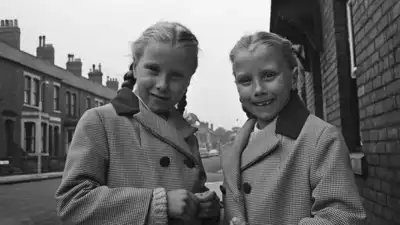
Pollock twins (Image: https://www.mirror.co.uk/)
In 1957, John and Florence Pollock lost their daughters, 11-year-old Joanna and six-year-old Jacqueline, in a road accident in Hexham, England. Because the story sits at an unusual crossroads: grief, childhood memory, coincidence and the long-running question of whether memories can exist without the experiences that supposedly created them, the Mirror has also revisited the strange case, which has continued to attract interest. He also confirmed that Gillian and Jennifer were monozygotic, or identical, twins.
Gillian picked out the doll that had belonged to Joanna, while Jennifer identified Jacqueline’s, according to accounts recorded by researchers. Gillian even recognised an old toy clothes wringer as hers and said Santa had brought it. Their parents said the girls seemed to know the way.
Imagine opening an old box of toys after years and watching two little girls immediately claim the dolls that once belonged to two children they had never met. That is one of the strangest details in the story of the Pollock twins. The family was devastated. A year later, Florence gave birth to identical twin girls, Gillian and Jennifer. At first, there was nothing unusual about them. Then, as the twins grew older, their parents began noticing things that were difficult to explain. When the girls were about three, toys belonging to Joanna and Jacqueline were brought down from storage. They also reportedly described the dolls as Christmas gifts, as they had been for the older girls. It was not just the toys. On another occasion, when their mother suggested they could have lunch at school, the twins replied that they had done that before, something that was not true of their own childhood, but had been true of Joanna and Jacqueline. Then there were the birthmarks. Jennifer had marks that the family believed corresponded to marks or injuries associated with Jacqueline. One was on her forehead, while another was on her waist. Years later, psychiatrist and reincarnation researcher Ian Stevenson examined the twins and documented the case in his research. This is where the story stops being simply an eerie family memory and becomes a much bigger question. Or could the explanation be much more ordinary, family conversations, information overheard as children, memories reconstructed by parents, or coincidences that became more meaningful after a terrible loss? That debate has followed the Pollock twins for decades. There is one detail that makes the Pollock case especially unsettling. The girls eventually grew up and the unusual behaviours faded. By adulthood, the twins did not continue describing themselves as their dead sisters often. The mystery, however, remained. And perhaps that is why the Pollock twins story has survived for decades. It does not offer a neat answer. It leaves behind a box of old toys, two little girls who seemed to know too much, and a question that science has never been able to settle to everyone’s satisfaction. You use AI every day. Now get your AI Quotient. Take the AIQ test Get the latest Lifestyle News and more. Download the TOI app.
When the family later returned to Hexham, the twins reportedly wanted to go towards a park and its swings before they could see them.