
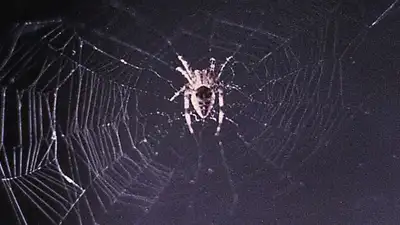
In 1973, NASA sent two spiders into space to test web-building without gravity: How Arabella and Anita learned, adapted, and spun complete webs in orbit.
In 1973, NASA slipped two cross spiders into a Skylab mission, asking a question so simple it almost feels like a kid’s science fair project: Can spiders still build proper webs when there’s no gravity pulling them down? Per NASA, it was dreamed up by Judith Miles, a Lexington high schooler who was just 17 at the time. Because the spiders’ senses and motor skills were getting scrambled without gravity’s guidance, examining the webs that came back down, scientists noticed the threads in space were far finer—probably. Because of dehydration, which makes it a lot less dramatic than re-entry or some sci-fi disaster, nASA’s logs suggest they died.
Through NASA’s student experiment program, she proposed “Web Formation in Zero Gravity,” wondering if spiders could manage without one of their main environmental cues. Imagine being so lucky that you get sent to space by NASA, without slogging for years to don the spacesuit! Arabella and Anita were those lucky chaps… err, spiders! The answer wasn’t obvious at first, as Arabella’s first web looked like a tangled mess. But after just a couple of days, something amazing happened. She spun a nearly perfect web, right there in orbit, miles above Earth. Anita gave it a shot next, and before long, both had adapted to their bizarre new surroundings, perfecting their technique with each web. Each strand and spiral turned into a visual note: a message showing just how living things can adjust when everything they know flips upside down. But here’s the part that makes this whole story so charming: this experiment didn’t come from a legendary scientist at NASA. On Earth, spiders use everything from gravity to tiny vibrations to help figure out this whole web-building puzzle. Without gravity, Miles figured, all bets were off. So NASA went for it. Arabella and Anita hitchhiked into orbit alongside astronauts, fish eggs, mice, flies — the usual weird animal menagerie scientists love to send into space. At first, Arabella just threw some lines together, as if she was just testing things out. But soon, she found her footing, spinning a web that actually held together. Each attempt got better. NASA records say they kept adding more radial threads, tweaking their designs, and adapting fast. Owen Garriott, one of the astronauts, watched Arabella figure things out in real time—and, honestly, was impressed by how quickly she learned. The story most often heard is, “NASA sent spiders to space, and the spiders figured out how to spin webs without gravity. That’s true, but the real story is richer. Their space webs weren’t copy-paste versions of the neat ones they spun back on Earth. The first space webs lacked the normal tidy circular pattern, but on subsequent tries, the spiders started adding symmetry back in, like they were learning and experimenting. It wasn’t just a curious sideshow, either. The experiment gave researchers a way to watch how a living thing’s brain and body respond when the familiar rules disappear. On Earth, humans (and spiders) take gravity for granted. It gives us balance, helps us know which direction is up, and shapes pretty much everything we do. Take it away, and your body and brain have to improvise. Watching the spiders, one could literally see the learning process, right there in the shifting geometry of their webs. What started as chaos became order again, proof that even tiny creatures can adjust to wild new circumstances. The story, though, doesn’t get a fairy-tale ending. Neither Arabella nor Anita made it through the entire mission. Anita passed away first, followed by Arabella, their remains memorialized as a quiet footnote to the history of space exploration. Anita now rests with the Smithsonian’s Air and Space Museum, a tiny, delicate symbol of curiosity’s power. Fifty years later, those silent spiders, spinning their improbable webs in orbit, still capture the imagination. And the real lesson isn’t just that spiders can handle weightlessness; it’s that life, even in utterly unfamiliar circumstances, can figure out how to adapt, sometimes in only a matter of days. Whether you’re eight-legged or an astronaut, sometimes the trick is letting go of the old rules and learning to build something new, even if it doesn’t look perfect at first. Looking for trusted parenting advice? Follow TOI Parenting Circle on Instagram for expert guidance, relatable stories, and practical tips delivered every day.