
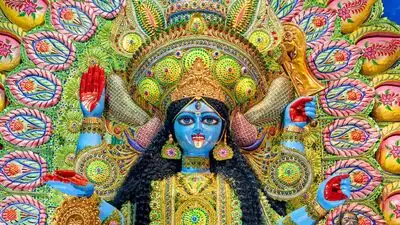
Across the western and central belts of India, the festival of Diwali revolves around the worship of Goddess Lakshmi and Lord Ganesha. This culture and custom of these regions reflects a centuries-long convergence of traditions, agricultural harvest cycles, and Vaishnava theology. Lakshmi represents prosperity and wealth, while Ganesha is invoked to remove obstacles and grant wisdom. It is believed that worshipping them together symbolizes beginnings for the coming lunar year.
Because the community dedicates the moon night entirely to Lakshmi’s grace and material abundance the subsequent pitch‑black new moon night of Diwali is when Goddess Kali is invoked as the ruler of transformation and time.
The divine name Kali originates from the Sanskrit word Kāla, which signifies both “time” and “darkness. Interestingly, in Eastern India, Bengal, Assam, and parts of Odisha, the night of Diwali takes a completely different spiritual turn. Known locally as Kali Puja or Shyama Puja the festival honors Goddess Kali, the manifestation of the divine devi, which is a result of deep Tantric roots, regional calendar traditions, and historical royal patronage that favored Shaktism over standard rites. The tantric philosophy of Amavasya Diwali occurs on the Kartik Amavasya, the moonless night of the Hindu month of Kartik. In the philosophy of Shaktism physical darkness is not something to be feared but the unmanifested cosmic ocean from which all creation arises. While light is kindled to push shadow Tantric practitioners view this midnight hour as the ultimate moment to confront spiritual darkness. It is believed that worshipping Kali on the night of the year symbolizes the destruction of the ego, ignorance and negative cosmic forces. Through this midnight worship devotees seek liberation from mortality and inner illusion as mentioned in Mahanirvana Tantra: Outlines the supremacy of Adya Kali (the energy) as the beginning and end of all creation reinforcing why her worship takes precedence on the darkest night of the year. Misconception of Lakshmi’s absence There’s a perception that Bengal rejects the worship of Goddess Lakshmi during the Diwali season. However in the part of India it is mainly a relationship with the Goddess of Wealth but it aligns her worship with a different phase of the lunar calendar. In Bengal Goddess Laxmi is worshipped on the night of Sharad Purniman. This day is celebrated as Kojagari Lakshmi Puja. This day falls during the moon night occurring five days after Durga Puja. The conquest of evil The basis for worshipping Kali on this night traces back to her battle against the demon army of Shumbha and Nishumbha. During the conflict the formidable demon Raktabija posed a threat as every drop of his spilled blood created a clone of himself upon touching the earth. As mentioned in the Devi Mahatmya (Markandeya Purana, 6th Century CE) serving as the text describing Kali’s miraculous origin, her destruction of Raktabija and her role as the ultimate defender of cosmic order it was believed that to overcome this multiplying evil Goddess Kali emerged from the forehead of Goddess Durga.
The transformation of Kali Puja into a mainstream festival began in the century through the influence of the scholar‑saint Krishnananda Agamavagisha as mentioned in Brihat Tantrasara by Krishnananda Agamavagisha (16th century CE) who drafted over 170 ancient Tantric texts into a single ritual manual detailing the precise liturgy for invoking Dakshina Kali during Kartik Amavasya. The centurys cultural shift King Raja Krishnachandra Roy of Nadia (1710–1783) was a devotee of the Goddess and a powerful regional ruler.
According to folklore he received a vision instructing him to depict the goddess as a dark‑skinned mother figure with unbound hair stepping on Shiva with her tongue extended. She consumed Raktabija’s blood before it could touch the ground completely eradicating his forces. Overcome by battle fury Kali performed a dance of destruction that threatened to shatter the universe. To calm her Lord Shiva laid himself down in her path. Upon stepping on her consort Kali realized her action. Stuck out her tongue in shock and remorse. This specific form, known as Dakshina Kali is the icon worshipped on Diwali night. A authority on Tantric scriptures from Navadwip Krishnananda codified the iconographic form of Dakshina Kali. His seminal work laid the foundation for bringing Tantric ritualism out of circles and, into domestic clay‑idol worship. He mandated the celebration of Kali Puja across his domain, subjects who built elaborate clay shrines. Raja Krishnachandras endorsement transformed Kali Puja from a ritual into a socio‑cultural event. Wealthy landowners (zamindars), across Bengal followed the lead sponsoring midnight pujas, community feasts and celebrations. You use AI every day. Now get your AI Quotient. Take the AIQ test Get the latest Lifestyle News and more. Download the TOI app.
Tracing the history of Kali puja Historically Kali was worshipped by Tantrics in remote cremation grounds using abstract sacred diagrams (yantras) rather than public household images. Over time this Eastern tradition permanently merged with the timeline of Diwali establishing a distinct festival identity that endures today.