
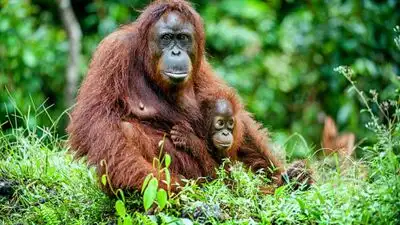
Image credit: iStock
The year 2026 was a year of losses and small miracles for the world’s only great ape living only in Asia. Every August 19, conservationists, scientists, and forest communities pause to mark World Orangutan Day. Identified only in 2017, it was long believed to survive solely in the Batang Toru forest of North Sumatra, with a population hovering around 716 individuals. So it came as genuinely exciting news in September 2025 when researchers confirmed a second, previously unknown population living in a peat swamp forest in Lumut Maju village in North Sumatra, roughly 32 kilometers from Batang Toru. An estimated 58 Tapanuli orangutans were killed which was a staggering blow for a population already teetering on the edge. Add to this the steady creep of small-scale farming and logging, which together account for around 70% of direct forest loss, plus larger industrial threats like the Batang Toru hydropower plant and the Martabe gold mine, and it becomes clear why this species remains one of the most endangered great apes on the planet. In July 2026, a Sumatran orangutan named Bulan gave birth in the wild, seven years after she herself was reintroduced to the forest following a life disrupted by wildlife trafficking. A 2026 population assessment found that the Sumatran orangutan population dropped by 19.5% between 2011 and 2023 alone. In March, Mongabay reported that a palm oil company had cleared more than 3,000 hectares of forest inside a UNESCO biosphere reserve, land that was supposed to carry special protection. In May, flames tore through more than half of a 300-hectare orangutan habitat restoration site in West Kalimantan, undoing years of patient regrowth in a matter of days.
Because for these three species, attention may be the only thing standing between them and disappearing altogether, it’s about paying attention,. Her baby became the tenth confirmed birth among reintroduced orangutans at the Jantho reservation in Aceh province.
“This birth demonstrates how orangutans, once victims of the wildlife trade, can be given a second chance to live and reproduce in the wild,” said Ujang Wisnu Barata, head of the Aceh provincial conservation agency, in comments to Mongabay contributor Ayat S. Though it is not a celebration in the usual sense. It is more like a check-in, a moment to ask how the world’s only Asian great apes are faring on an island chain that keeps shrinking under them. Across Sumatra and Borneo, the story of the orangutan right now is one of resilience meeting relentless pressure, and it’s worth slowing down to understand what actually happened. Of the three orangutan species, the Tapanuli is the youngest to science and the smallest in number. For a species this rare, discovering an entirely separate group was a rare piece of good fortune. That optimism didn’t last long. Just two months later, Cyclone Senyar tore through the region, triggering tens of thousands of landslides across Batang Toru. Not all the news this year was grim. Karokaro. It’s a quietly remarkable achievement when you consider that female orangutans breed only once every seven or eight years, the longest birth interval of any mammal on Earth. Every single birth counts enormously toward a species’ survival. But the bigger picture is still troubling. Even with stories like Bulan’s, the broader numbers tell a harder truth. Individual conservation wins, however heartening, are happening against a backdrop of steady overall decline. Across the sea in Borneo, the pressures look different but the outcome is similarly bleak. Industrial agriculture continues to nibble away at exactly the habitats orangutans depend on to survive. Fire has become an increasingly persistent threat too. Then in August, another fire reached the edge of an orangutan rehabilitation center, a close call that has conservationists on edge. With El Niño expected to deepen drought conditions across the region in the months ahead, the risk of further fires looms large. World Orangutan Day isn’t really about celebration. Looking for trusted parenting advice? Follow TOI Parenting Circle on Instagram for expert guidance, relatable stories, and practical tips delivered every day.