
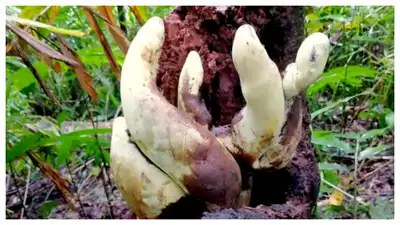
As per a report published in the journal of ScienceDaily on ‘Chinese scientists discover “D-rex,” a giant fungus with roots stretching back 65 million years’, it was found that something truly changed about what people thought about how big a fungi can turn! Can you imagine a fungus that’s not just massive but is also one of the oldest types of fungi, with a history that dates back to the era of dinosaurs? Well, all this may sound bizarre, but it is true that scientists have recently discovered a huge fungus known as D-rex. It is believed that it hails from the deep in the forests of Yunnan Province in China. What’s more, D-rex is not huge, but it also holds an evolutionary tale that goes back to the time just after dinosaurs vanished. Here’s more about it.
In August 2024, researcher Jing Song gathered a looking fungus on oak tree roots in Yunnan. With a team from China, Thailand, and Mexico, scientists finally confirmed that this was a brand‑new species for science. The discovery started by accident. A month later another researcher, Indunil Senanayake, discovered a second sample in the same village, unaware of the first find.
Officially called Dianjunus rex, D-rex develops fruiting bodies that reach up to 50 centimeters in height and weigh up to 2.2 kilograms, making it the biggest known fungus in the Ascomycota group, which contains more than 64,000 documented species. Earlier record‑holders of this kind of fungus usually topped out at 20 to 30 centimeters, so D-rex truly broke the limits for size. With a method called molecular clock analysis, which compares differences between species to estimate when their evolutionary branches split, scientists traced the beginning of D-rex’s family, Dianjunaceae, back to about 65 million years ago. How much is yet to discover With more than 6,000 fungal species already recorded in the area and experts estimating that over 100,000 species may still lurk there, scientists say this find shows that fungal diversity in East Asian forests is still far lower than reality.
D-rex, therefore, is not only a record‑breaking organism but also a reminder of how much of the natural world remains to be discovered.
Dianjunus mixes a nod to the Dian Kingdom, a civilization that thrived in Yunnan during the second and first centuries BCE, with the Chinese word for fungus, according to the research team. Rex, Latin for “king,” was chosen to highlight D-rex’s commanding, record‑breaking size. Name with the weight of its history The name is not a playful reference to Tyrannosaurus rex. Unexpected link to the dinosaurs’ extinction This is where D-rex becomes truly fascinating. That date places the family’s start one million years after the Cretaceous‑Paleogene mass extinction, the event that famously killed dinosaurs and many other species. Scientists think this timing is not a coincidence. Why it grows so unusually large D-rex was found on the roots of Chinese cork oak trees emerging from the rhizosphere, the thin layer of soil around plant roots. As per scientists, think D-rex may have a life: it grows quietly inside healthy trees then shifts to feeding on dead wood when the host tree dies, using that energy to build huge fruiting bodies. Researchers believe D-rex’s enormous size helps spread spores by wind, useful in crowded forest conditions. Fungi are seasonal, easy to miss, and have been studied less than species with economic value. You use AI every day. Now get your AI Quotient. Take the AIQ test Get the latest Lifestyle News and more. Download the TOI app.
The study’s authors argue that the ecological upheaval after the extinction opened niches for wood‑decomposing fungi, giving D-rex’s lineage space to emerge and specialize in ways that were impossible earlier.
A fungus no one expected to be so big