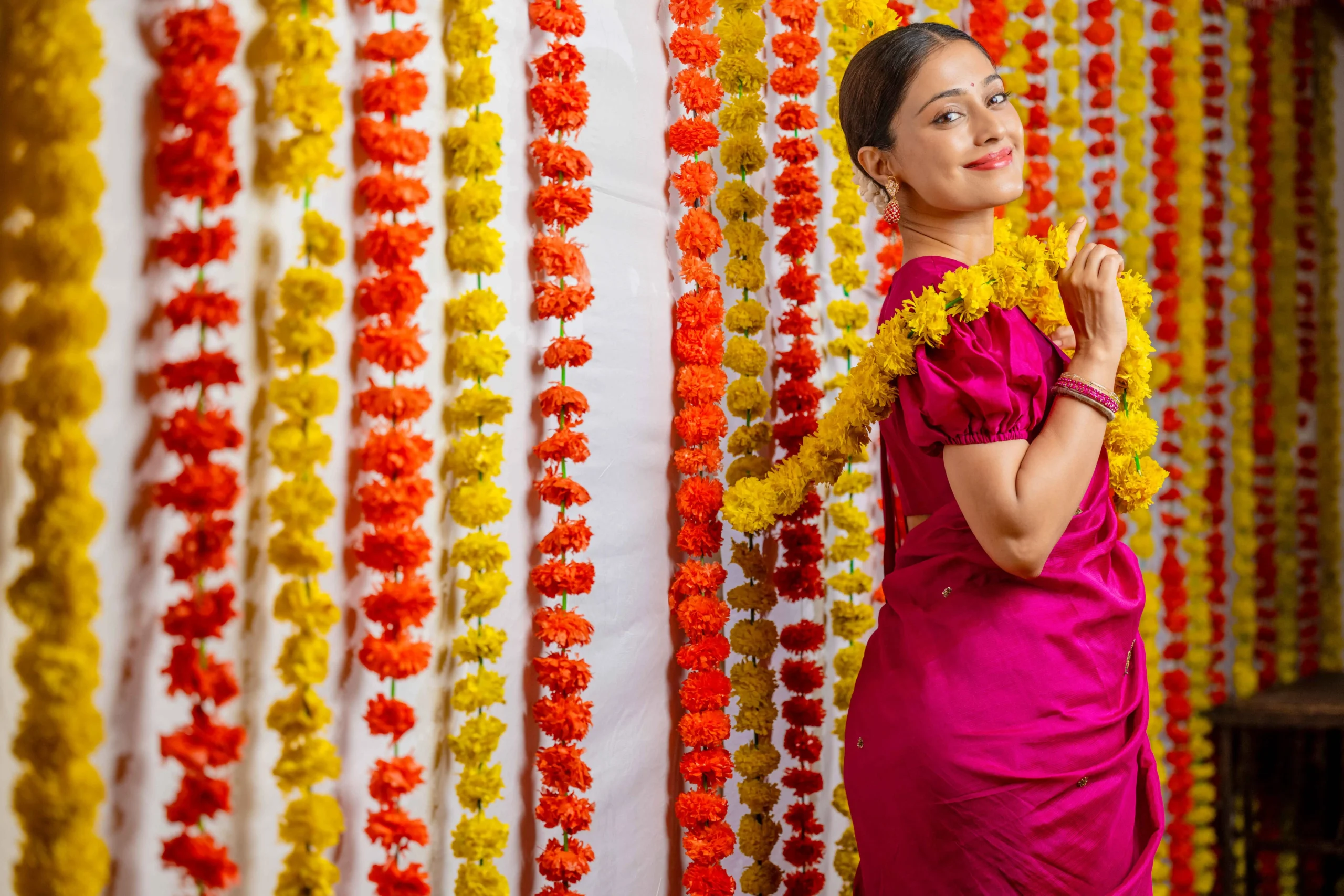
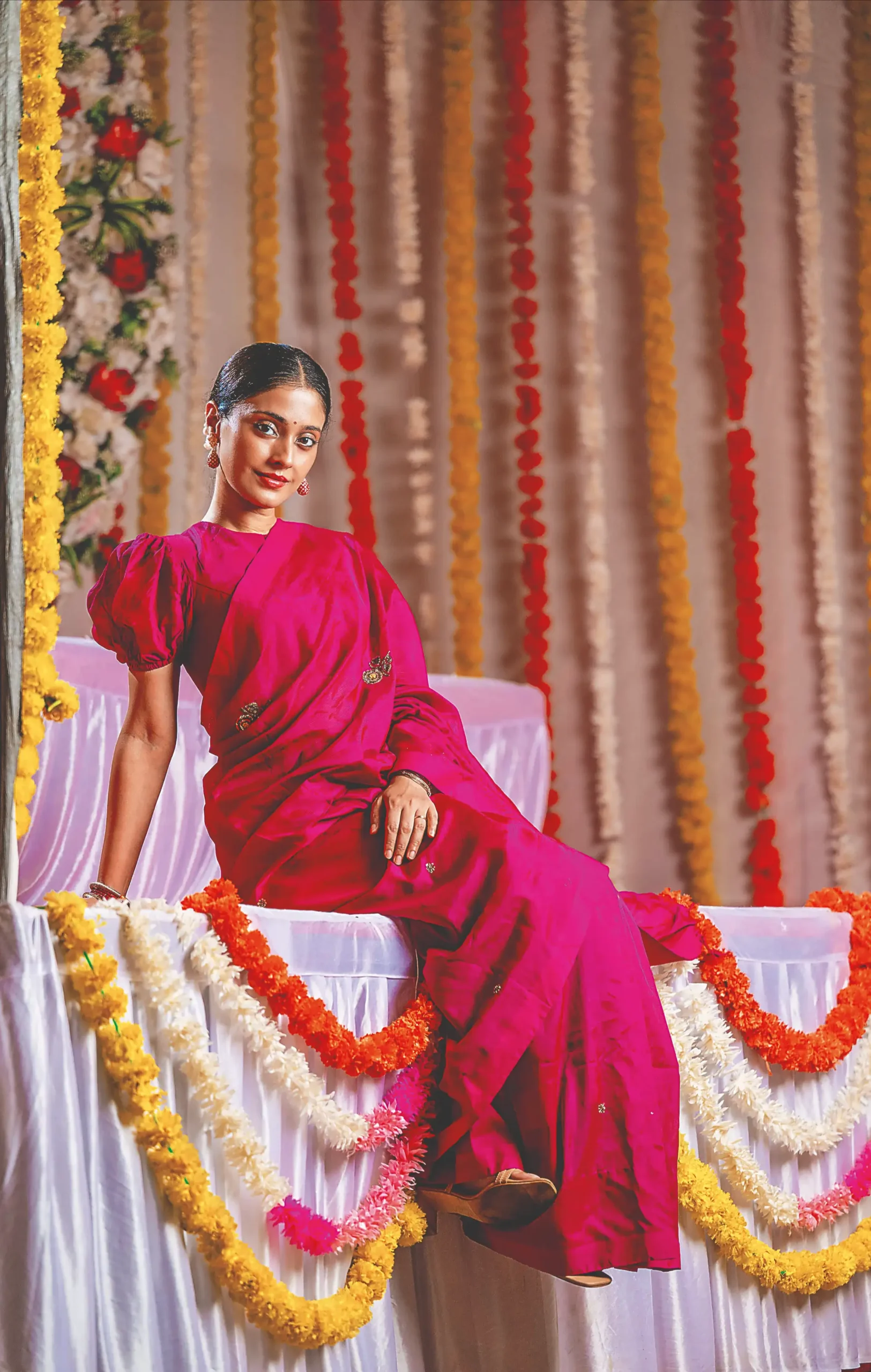
There is a certain Kolkata that exists in Amrita Bagchi ’s memories – Mahalaya mornings, neighbourhood Pujo rehearsals, new clothes, and grandparents dropping in during the holidays. Years later, that world remains intrinsic to the actor, even as her work moves from independent cinema to mainstream streaming. Recently seen as Alka Ahuja in Operation Safed Sagar, the Kolkata girl opens up about the role, her childhood Pujo memories and more.
What Pujo means to Amrita I still play Birendra Krishna Bhadra’s Mahishashur Mardini at dawn on Mahalaya, no matter where I am. I remember how rehearsals for Pujo functions would start a month prior, with such madness over costumes, dance steps and dialogues for the plays! Those were happy days. My grandparents would visit us and everyone would be in good spirits. Not to forget the food that was delicious! Then came the Pujo gifts. Ebela eta porbo, obela oita porbo, omuk porey anjoli debo. The memories are endless. Kolkata is my foundation; it’s a state of mind for me: Amrita You’re a Kolkata girl. What part of the city did you grow up in? Kolkata is my foundation. I grew up in Santoshpur, Jadavpur, and Alipore – playing with friends in our para. My grandfather, Dr Sarojit Bagchi, was a popular doctor and children’s writer in Jalpaiguri who wrote under the pseudonym, Ratnaakar, and self-published his work. Whenever he visited, he’d tell me stories after dinner, walking up and down while I trailed behind him wearing his giant sandals. Cosying up with the shaarodiya editions of Bengali newspapers during Pujo vacations is another precious memory – I still make sure to get them every year. I retain every bit of that girl: the music, films, literature, food, architecture. Kolkata is a state of mind for me. You’ve worked across mainstream streaming projects and independent cinema, but you seem particularly drawn to the latter. What is it about the independent filmmaking space that gives you something creatively that larger productions perhaps do not?
How much of that stays with you today?
Because what defines indie is the lack of larger resources, heist films, murder mysteries, love stories, screwball comedies – can all be a part of independent cinema,. Because it trains you to perform in any situation, it’s always exciting to be a part of something like that. He can make moments out of very tiny things, like a railway light or a lost pen.
There are many wonderful storytellers there and I like that slowly there is a resurgence of filmmakers who are showing Bengal as a character and not just a geographical setting -Amrita Bagchi Playing Alka Ahuja: “The martyr & mourner now both live within one person” For Amrita, stepping into Alka Ahuja’s shoes in Operation Safed Sagar, was about honouring the human cost behind the military mission. “She didn’t suddenly become brave after the tragedy,” she says. “She always had tremendous grit” — grit that carried her through a second loss – her father’s death just six months after Ajay’s. The makers, Amrita says, deliberately resisted the “familiar image of a war widow,” and instead showed a woman who rebuilt her life on her own terms — running a petrol pump for 25 years, still capable of forgiveness, still whole. Amrita Bagchi says she doesn’t worry about how people categorise her.
Independent cinema and theatre welcomed me before mainstream did. It was also the window through which I entered the world of performance. So independent cinema feels like ‘the source’, a safe space for me. Also we must understand that indie cinema is not a genre, its an economic category. Since there’s barely any money to make these films, the filmmakers come up with unique experimental ways to achieve their vision. That gives birth to new forms. It’s a very special kind of training. Indie productions and larger productions both have pros and cons. Finite resources means low stakes, more time, and easier pace – but it also means there is no guarantee of distribution. You may give years to a film but it may never find a release. You may never recover the cost. With larger productions, you have all the resources, crew and permissions and a guaranteed release. But there are studios and timelines and approvals and, in general, much higher stakes. The pressure is immense. You are vulnerable in so many other aspects. Working with Anurag Basu on Tagore Stories, particularly with material inspired by Tagore’s writing, must come with its own creative expectations. What was your biggest takeaway from it? Tagore’s work, especially for us Bengalis, comes with a certain grandiose. He distilled it into small everyday moments which add up to enormous depth. And he does it very playfully. I loved that sense of wonder. A lot of interesting indie films are also happening in Bengal. Meeting the real Alka was, in her words, “a complete revelation. A quarter century on, Alkaji still keeps her husband’s coffee mug, his chair, his letters – what the actor calls “material memory. During their meeting, Alkaji handed over Ajay Ahuja’s original flying patches, asking her to pass them on to Siddharth for the show. Yet grief never curdled into bitterness. That resilience shaped every choice on screen. “Being multi-disciplinary has worked in my favour. It brings perspective to my own work” You use AI every day. Now get your AI Quotient. Take the AIQ test Get the latest Lifestyle News and more. Download the TOI app.