
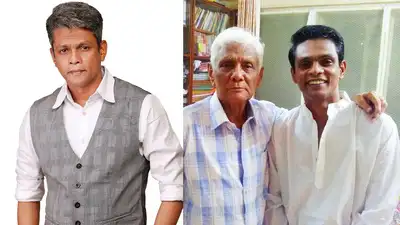
With over 150 songs to his credit and more than three decades of work across poetry, songwriting, acting and production, Ayaz Gorakhpuri has explored a wide range of musical and literary forms. His work includes folk and lok geet compositions such as Badnam Na Karo, Apne Nikle, Chiffon Ki Saari, Udan Khatola and Saawan Mein, alongside contemporary tracks that explore the changing dynamics of love and relationships. The son of Urdu poet Zafar Gorakhpuri, Ayaz draws from a literary inheritance while finding subjects in the realities of everyday life, from traditional romance and heartbreak to social media, digital communication and urban culture. He talks about balancing literary traditions with contemporary themes, keeping folk music relevant and observing the changing language of human relationships.
Over the years, I have written more than 150 songs, and I have tried not to repeat myself. You have worked across ghazals, nazms, Hindi geets, Sufi compositions and folk music. How do you approach such diverse musical forms? I have always believed that every musical form has its own language and emotional character. A ghazal, a nazm, a geet or a folk composition cannot be approached in the same way. Each demands a different sensibility. My subjects may revolve around love, relationships, separation or everyday experiences, but the treatment and expression have to be different. I want the writing to reflect the mood of the composition rather than force every emotion into a familiar structure. Folk music and lok geet form an important part of your body of work. What draws you to these traditions? Folk music is closely connected to the lives of ordinary people. It carries their language, experiences, humour, relationships and cultural memories. I have always felt that these traditions deserve to be part of contemporary musical conversations rather than being restricted to a particular audience or generation. Songs such as Badnam Na Karo, Apne Nikle, Chiffon Ki Saari, Udan Khatola, Ka Ho, Milne Aaye, Pahle Ka Prem, JumboJet, Saawan Mein, Mukhbari, Bangkok, Bahrupiya, Badami, Amwa Ki Dari and Manbasiya reflect my engagement with this space. For me, the challenge is to retain the character of folk music while allowing it to evolve with changing musical tastes. Your recent work also engages with Gen Z relationships and expressions such as changing display pictures, emojis and the friend zone. How do you find poetry in these contemporary experiences?
Because it is new, technology is a tool, and there is no point in resisting change simply. Because it offers an enormous range of characters, situations and cultural influences, i enjoy observing urban life. The vocabulary of relationships has changed considerably. But the emotions behind these actions have not changed as much as we think. People still experience insecurity, jealousy, longing, attraction and heartbreak. The difference is in how these emotions are expressed. When I write about a Wish Nahi Kiya, an Emoji Wala Dil or the transition from being a friend to something more, I am observing what is happening around me. Songs such as Hide and Seek, Silent Mode, Teri Zid Ke Aage and Dekh Lete Hain explore these changing dynamics. I don’t think contemporary subjects make poetry any less meaningful. If anything, they offer new ways of looking at familiar emotions. Do you think social media has fundamentally altered the way people experience love and relationships? It has certainly altered the way people communicate and interpret each other’s behaviour. A delayed reply, an unread message or a change in someone’s online presence can become a matter of considerable emotional speculation. There is a tendency to analyse everything. At the same time, people are constantly connected digitally but may not necessarily feel emotionally connected. I find these contradictions interesting as a writer. The digital world gives us endless ways to communicate, but it does not automatically make relationships easier. Technology can help us express ourselves, but it cannot replace genuine human understanding. These are the realities of our times, and naturally, they find their way into my writing. You have also explored themes of emotional isolation and the growing influence of technology, including artificial intelligence. Does this concern you as a creative person? Artificial intelligence and digital platforms have their uses, but creativity also comes from personal experiences, observations and emotional understanding. A machine can process information and generate language, but the experiences that shape a writer’s perspective are deeply personal. I am interested in observing how people are responding to these changes. We are living in a time when there is an abundance of communication but also a sense of isolation. That contradiction is worth exploring. I would rather engage with these developments through my writing than dismiss them outright. Being the son of renowned Urdu poet Zafar Gorakhpuri, how much has your literary upbringing influenced your approach to writing? Growing up around poetry inevitably shapes your sensibility. My father’s work and literary journey gave me an early understanding of language, expression and the importance of observation. However, I have always felt that an artist must eventually find an individual voice. You can inherit an appreciation for literature, but your experiences and perspective determine what you create. I respect the tradition I come from, but I don’t want to limit myself to one particular form or subject. I enjoy exploring different genres and writing about the world around me. For me, the literary inheritance is a foundation, not a boundary. You move between traditional poetry and subjects rooted in everyday urban life, including Mumbai’s local culture and food. Do you believe poetry should move beyond conventional literary spaces? Absolutely. Poetry is not restricted to books, libraries or mushairas. It exists in everyday conversations, street corners, markets, local traditions and the way people describe their experiences. The language people use in their daily lives can be just as expressive as formal literary language. Even something as ordinary as local food or a familiar neighbourhood can become an interesting subject when viewed from a different perspective. I don’t believe poetry should become inaccessible by being overly conscious of its literary status. It should be able to connect with people, regardless of whether they regularly read poetry. After more than three decades in the creative field, what continues to inspire you to write? Life itself continues to provide subjects. Human relationships, changing social behaviour, cultural traditions and the everyday experiences of people are all sources of inspiration. I don’t think a writer can afford to stop observing the world around them. At the same time, one must remain open to new forms of expression. I have worked across different genres, and I would like to continue exploring them without being confined to a particular image or expectation. Ultimately, I want my writing to remain connected to people and their experiences. If someone finds a reflection of their own life or emotions in a song or a poem, that connection is what makes the effort worthwhile. You use AI every day. Now get your AI Quotient. Take the AIQ test Get the latest Lifestyle News and more. Download the TOI app.
Earlier, people waited for letters or telephone calls; today, they look for messages, reactions, display picture changes and online activity.