
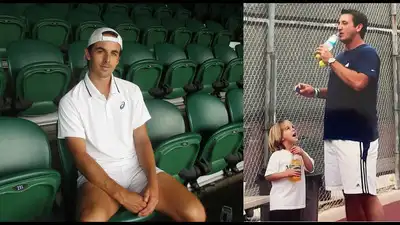
- After losing his father, Zachary Svajda returned stronger, producing a Grand Slam breakthrough and reaching a career-high No.
Last September, Zachary Svajda was in China preparing for a three-week Asian swing when his father’s Stage 4 cancer suddenly worsened, forcing him to abandon the trip after just four days and fly home to California. 62. The timeline begins on August 27, 2025, when Svajda walked into Arthur Ashe Stadium for the second round of the US Open to face Novak Djokovic, the 24-time major champion. Svajda left New York and boarded a flight to Asia soon after the tournament, planning to spend roughly three weeks competing across China as he continued his push towards the ATP Top 100. Tom had been battling Stage 4 cancer since 2024, and by September 2025 his condition was entering its final stages. Tom died peacefully surrounded by his family on October 13, 2025. He had spent the final months of 2025 grieving and processing the loss of the person who had taught him the sport, and the first competition of 2026 became his first opportunity to discover what returning to that sport would feel like without his father beside him. Svajda began his 2026 comeback at the Australian Open in January, successfully navigating the qualifying rounds to earn a place in the main draw for the first time. A week later, the schedule brought him back to southern California for the ATP Challenger event in San Diego, a tournament staged about 10 minutes from the place where he grew up. 15 Sebastian Korda 6-4, 7-6(5) to win the San Diego title from January 27 to February 1. On February 23, 2026, Svajda officially broke into the ATP Top 100 for the first time. Clay was not his preferred surface, but on May 30 he produced the biggest Grand Slam victory of his career against 25th seed Francisco Cerúndolo. The match stretched into five sets, with Svajda battling through cramping and the momentum repeatedly shifting between the two players before he eventually prevailed 6-3, 6-4, 3-6, 4-6, 6-3. The victory sent him into the fourth round, taking him into the second week of a Grand Slam for the first time and temporarily lifting him 26 places to No. 59 in the PIF ATP Live Rankings. 62 on June 8, once the rankings were fully updated. On July 4, Svajda reached the third round at Wimbledon after defeating Pablo Llamas Ruiz and Kamil Majchrzak before eventually losing to Alex de Minaur. The North American hard-court swing then brought another significant victory on August 4, when Svajda defeated former world No. 10 Denis Shapovalov at the Montreal Masters. At the US Open on September 2, Svajda defeated Germany’s Daniel Altmaier in a physical, rain-delayed four-set battle, adding another win at the tournament where his previous season had ended with his match against Djokovic. By late September 2026, Svajda had completed his North American campaign and moved into the Asian hard-court swing, returning to the region where his 2025 season had been cut short by the news of his father’s deteriorating condition. His latest stop was the Japan Open Tennis Championships in Tokyo, where he faced fellow American Aleksandar Kovacevic in the first round of qualifying on September 28. Svajda produced 19 aces and took the opening set in a tight tiebreak, but Kovacevic recovered to win 7-6, 2-6, 4-6 and end his run in qualifying. 80 in the ATP singles rankings, still close to the Top 100 after reaching No. 62 earlier in the summer. Join conversation Share your thoughts in the comments Be respectful · TOI community guidelines On September 28, 2026, he was back in Asia competing again, this time as a player who had already reached the fourth round at Roland Garros, the third round at Wimbledon, the second week of a Grand Slam for the first time, a career-high No. 62 ranking and victories over players such as Shapovalov. Stay updated with the latest Asian Games 2026 news , check the Asian Games medal tally and complete Asian Games schedule .
Because it was the last match Tom Svajda ever watched his son play, djokovic eventually defeated him in four sets, but the match acquired a much deeper significance in the weeks that followed. Because he did not want to default, although he later acknowledged that he struggled to focus and eventually suffered defeat, he nevertheless went out to play. Because the next tournament had arrived, when he eventually returned to tennis, it was not simply. Because may 30 would have been Tom’s 61st birthday, the date made the victory even more personal. Because his father was dying, in September 2025, Svajda arrived in China intending to spend three weeks competing, played one match, struggled to focus through tears and flew home after four days.
When Svajda finally won match point, he fell to the clay in tears. The live ranking updated immediately after his fifth-set victory, reflecting the points he had secured by reaching the fourth round.
Doctors told the family that Tom’s condition had deteriorated drastically and that “it could be any day”. “I’m coming home and taking care of you guys,” Svajda told his mother, before booking a flight back to California that night. “I was like, ‘I’m done, family comes first and there will always be tournaments.’” Once he returned to California, Svajda stepped away from professional tennis completely and shut down the remainder of his 2025 season. “I remember one of the last things my dad said to me was like, ‘I’ll be okay, just go play’, that’s what made him happy,” said Svajda. “He taught me everything because I was homeschooled my whole life, so I was with him 24/7 on the tennis court and at home,” said Svajda. “I said to my team, ‘I don’t think I want to play San Diego because it just feels weird going back there with everything that happened with my dad’,” recalled Svajda. “I remember when I won my semi-final match and moved on to the final, I was talking to myself in my head, ‘I wish dad was here’,” Svajda said. “I thought it was so cool to have a trophy like that, it’s different from all the other ones out there,” Svajda said.
A month later, Tom Svajda died. Almost a year on, Zach has returned to the same part of the world after a season that has taken him through the Australian Open, a Challenger title, a historic run at Roland Garros, Wimbledon and a career-high ranking of No. It was the biggest match of Svajda’s career to that point and, until his run in Paris the following year, it represented his deepest progress at a Grand Slam. The trip was supposed to be another important stretch in his development, but his father’s health had already become the dominant concern back home in California. Before his opening match, the pressure of knowing what was happening at home became overwhelming and Svajda broke down in tears. The news that followed made the decision about the rest of his trip straightforward. Svajda called his mother immediately, but his father had become so ill that he could no longer speak. He had spent only four days of a planned three-week trip in China, and as he later recalled the decision to leave, there was no debate about where he needed to be. He did not simply stop entering tournaments; he refused to hit a tennis ball while he stayed with his family through the final weeks of his father’s illness. There had been a point, in the aftermath of the US Open and before Tom’s death, when Svajda had seriously considered ending his season so he could remain at home with his family. Tom, however, did not want that to be the reason his son stopped playing. It was a particularly difficult instruction for someone who had spent his entire life closely connected to his father through tennis, but it also reflected the relationship that had shaped Svajda’s career from childhood. Tom was a teaching professional at Pacific Beach Tennis Club in San Diego, and some of Zach’s earliest memories of tennis involved the two of them volleying a balloon back and forth across the living room when he was two years old. As Svajda grew older, the father-son relationship remained at the centre of his tennis development, with Tom teaching him while Zach was homeschooled and spending much of his time on the court with him. “He really taught me commitment and making the right decisions and also sacrifices. Svajda did not touch a racquet for a month after his father’s death, instead staying close to his mother and his brother Trevor while the family dealt with the loss. He also helped his mother relocate to Texas, where Svajda’s two brothers live. It was a meaningful first step back onto the Tour after the months away from competition, and it gave him an immediate platform from which to rebuild the season that had been interrupted by his father’s illness. The proximity to home also meant proximity to memories of his father, and Svajda was initially unsure whether returning to that setting so soon would be too difficult. He decided to play, and the tournament became one of the first major turning points of his comeback. With friends and family watching, Svajda reached the final and defeated former world No. It was the seventh ATP Challenger title of his career and his first major title since returning from the loss of his father. The victory also produced a moment that showed how closely the tournament remained connected to Tom. After winning his semi-final and reaching the final, Svajda found himself thinking about his father and wishing he could have been there to see what was happening. “I also thought about that while holding up the trophy or hitting an ace on match point. The San Diego organisers gave the champion a trophy that was particularly appropriate for a tournament played so close to Svajda’s home: a surfboard. “Definitely the biggest [trophy I have], and thankfully it was in San Diego, so I just put it in my trunk and with the windows down as well, drove it back home to L.A. that night. The result also accelerated his progress in the rankings. The player who had returned from Australia still carrying the loss of his father was now beginning to establish himself among the leading players outside the established elite. Svajda’s most significant breakthrough arrived several months later at Roland Garros, where he entered the French Open main draw for the first time. The run also carried a piece of history with it. Svajda became the first unseeded American man to reach the fourth round at Roland Garros in recent memory. He eventually finished the tournament with an official career-high ranking of No. The achievement was particularly striking when placed against where his season had begun. By June, he had reached the second week of a Grand Slam and established a new career high. The summer continued to add to the season. Shapovalov retired during the third set. Svajda entered the late-September Asian swing ranked No. The year between those two Asian trips contains the hardest loss of Svajda’s life and the most productive tennis season of his career, but the two are not separate parts of his story. Every time he steps onto the court, the player Tom taught from the age of two is still carrying what his father gave him: commitment, the willingness to make difficult decisions and the understanding that family comes first. Get the latest Sports News and Live updates. Download the TOI app.
Svajda managed to spend only four days in China before the situation became impossible to compartmentalise. Only months earlier, Svajda had been returning to competition after losing his father and trying to work out how tennis fitted into his life again.
His immediate focus now turns towards the Shanghai Masters and the possibility of securing a place in the main draw, while the final weeks of October and November are expected to take him between ATP 250 events in Europe and Asia and selected premium Challenger tournaments. There is also a practical ranking objective attached to those final weeks: Svajda wants to protect enough points to secure direct entry into the 2027 Australian Open main draw rather than having to return to qualifying.
That makes his return to Asia a very different trip from the one he made a year earlier.