
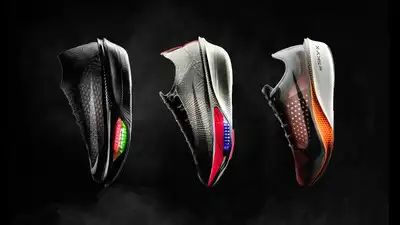
Nike’s new race-day hardware
The Alphafly 4, which goes on wider sale on October 29, sits between the two. Nike says Apex returns up to 40% more energy than the Alphafly 3, while the $145 Swooshfly beats the Vaporfly 4 by 16%, both measured in a men’s size 10. Apex takes the new Air Zoom units that debuted in the Alphafly 4 and doubles them up. Underneath is ZoomX LT, the foam Nike introduced with the Alphafly 4, which is up to 17% lighter than standard ZoomX.
Nike calls the trio a “race-day system of speed”, with Apex aimed at elite marathoners, Alphafly 4 at runners chasing personal bests, and Swooshfly at first-time racers. “Race day is one of the most meaningful moments in a runner’s journey, but that moment looks different for everyone,” said Bret Schoolmeester, Vice President of Nike Running Footwear. Nike has rebuilt its racing lineup around two new pieces of hardware. The new Nike Apex is the first racing shoe with double-stacked Air Zoom units, four in total under the forefoot, while the new Swooshfly debuts SkyX, a beaded foam built to last across multiple marathons. The claims are bold. Two pairs sit one above the other, compressing, storing and releasing energy with each stride, and Nike argues Air holds its performance better than foam across a full marathon. A raised carbon fibre Flyplate with an inverse-wave shape sits above the pods to direct load into them.
It weighs over 10% less than the Alphafly 3 and goes on sale in January 2027. Swooshfly is engineered for a runner who takes about 4.5 hours and roughly 55,000 steps to finish a marathon. So it cut the Flyplate from the eight carbon layers used in the Alphafly 4 to five, a number settled on after wear tests at its Shanghai lab. Swooshfly launches in China in February 2027, then globally that spring.
Nike says SkyX is already being lined up for future running shoes without a carbon plate, which would put the foam in front of a much wider set of runners than the race-day crowd. Apex also runs zero drop, with a 40mm stack at both heel and forefoot, plus a wider outsole and rocker shape for stability. Nike found that stiff plates tuned for forefoot strikers felt hard to control for this group. SkyX uses TPU beads steamed to different densities across the heel, plate and forefoot, putting more rebound under the heel where slower runners tend to land. A wider last with a lower arch fixes narrow fits, and GOATEK rubber adds grip at wet water stations. Of the three shoes, Swooshfly’s tech may travel furthest. The process behind it matters too. Swooshfly took about a year to develop, roughly half Nike’s usual timeline for a new model, and the company is now applying the same faster approach to ACG and training products. You use AI every day. Now get your AI Quotient. Take the AIQ test.