
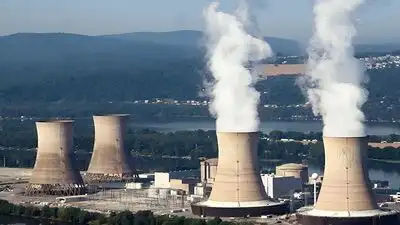
Representative Image
Data centres already account for nearly a quarter of the country’s electricity consumption, a share that is expected to reach at least 30% by 2032. Ireland first considered nuclear power during the 1973 oil shock, when the country was heavily dependent on imported energy. Plans for a nuclear plant on the south-east coast later faced strong opposition, with several high-profile protests beginning in 1978. The Three Mile Island reactor accident in the US in 1979 further turned public opinion against nuclear power. The country eventually prohibited nuclear fission power under legislation introduced in 1999. Data centres have become an important part of that technology infrastructure, but their electricity requirements have also become a major issue for the power system. Gas made up some 40% of Ireland’s electricity in 2025, official figures show, while wind accounted for 32% and net imports via interconnectors with Britain 16%. The country has also doubled its wind generation capacity in the last ten years. Offshore wind remains another part of the government’s plans, although Ireland has added relatively little offshore capacity since the Arklow project began operating 22 years ago. Ireland now allows new data centres to proceed provided they can meet 80% of their electricity requirements from additional renewable generation within six years. Supporters of nuclear power argue that the technology could provide another source of low-carbon electricity as demand continues to grow. The Irish Academy of Engineering has estimated that a fleet of small modular reactors could supply 48% of Ireland’s electricity by 2050. The country is also already indirectly exposed to nuclear-generated electricity through its electricity links with Britain, which operates nuclear power stations. A new interconnector with France is expected to be completed in 2028. Hannah Daly, professor of sustainable energy at University College Cork, said nuclear could not address the country’s electricity-price, supply-security and carbon-budget challenges within the next 15 to 20 years.
That position remained unchanged for decades, even as neighbouring countries such as Britain and France continued to use nuclear reactors as part of their electricity systems. One of the politicians pushing for a change is Fianna Fáil backbencher James O’Connor, who introduced a bill seeking to remove the legal barrier to nuclear power.
Speaking in the Dáil in May, O’Connor said, “Nuclear is the way to go,” pointing to Finland, a country with a similarly sized population that generates almost 40% of its electricity from nuclear power. Ireland has attracted major technology companies partly because of its tax regime, which has encouraged multinational companies to establish European headquarters and large operations in the country. France generates about 70% of its electricity from nuclear power. “We should be doing, in the 2020s, what the French did in the 1970s,” said Eamonn O’Reilly, chair of the energy and climate action committee of the Irish Academy of Engineering. “It takes a long time to get ready, hence we should start now,” O’Reilly said. Small modular reactors have also attracted interest because they could be deployed at smaller sites. Dave Kirwan, managing director of Centrica Power, whose parent company has a 20% stake in Britain’s existing nuclear power stations, said smaller reactors could be built at data centre sites. “I’m seeing real traction [in the UK] that could deliver quicker than you think,” he said. However, nuclear power would not provide an immediate solution to Ireland’s electricity challenges.
Ireland is reconsidering its long-standing ban on nuclear power as electricity demand from data centres continues to rise. This has prompted the government to reopen a debate that had been largely closed for more than five decades. A decision on the country’s first new offshore wind project since Arklow is due in September. O’Connor has argued that the country’s decision to prohibit nuclear power has increased its exposure to energy-supply problems. However, the government has not abandoned its focus on renewable generation.
Data centre electricity consumption increased by 10% in 2025 compared with the previous year, while consumption from all other users increased by about 2%. Daly estimates that data centres could account for 55% of Ireland’s electricity consumption by 2040 if their growth continues. Public opinion has also shifted compared with earlier years. An April opinion poll found that 43% of respondents wanted the nuclear ban removed, compared with 28% who wanted it retained. In 2021, support for and opposition to building a nuclear power station were both at 43%. Ireland’s finance, public expenditure and energy ministers have all indicated that a new discussion about nuclear power is possible, while continuing to prioritise renewable energy.
Taoiseach Micheál Martin recently told a business dinner, “We’re open to that [nuclear], according to a report by The Financial Times. Dublin had already imposed a de facto moratorium on new data centres in 2021 because the electricity grid could not keep pace with the sector’s growth. “Nuclear is certainly not something that can address any of those challenges in the next 15 to 20 years,” she said, adding that “nuclear will face the same, if not more, constraints as the offshore wind industry is facing — and offshore wind doesn’t rely on importing uranium”. She also warned that presenting nuclear as a single solution could delay renewable-energy projects. Renewable-energy developers have pointed to planning and grid constraints as immediate obstacles to increasing domestic electricity generation. Kieran White, chief executive of renewables company Perigus Energy, said Ireland needed to address those problems rather than focus solely on longer-term technologies. “The risk is that we spend too much time debating theoretical future options while forgetting the deliverable projects that are key to unlocking lower-cost, homegrown and green power this decade and the next,” he said. The scale of future data centre demand is another reason the nuclear debate has gained attention.
The shift marks a change in Ireland’s approach to nuclear power, which has remained politically and legally off the table for decades. His comments came as the government faces growing pressure to expand electricity generation while meeting rising demand from data centres and other large users. The debate has now returned as Ireland’s electricity requirements change. The outcome of O’Connor’s bill remains uncertain. Get the latest technology news and updates. Download the TOI App.