
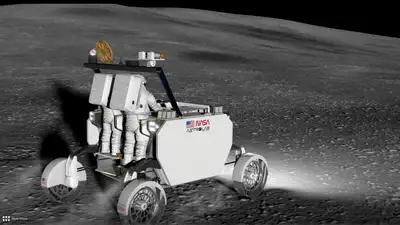
A historic computing milestone is set to reach the lunar surface later this year as California-based space company Astrolab prepares to launch its uncrewed moon rover, FLIP, equipped with Hewlett Packard Enterprise’s (HPE) Spaceborne Computer-4. The launch will mark the first time high-performance computing, graphics processing units (GPUs) and artificial intelligence (AI) experiments are deployed and tested directly on the moon. Testing next-gen computational hardware in deep space is viewed as a vital step to support future human habitation and long-term economic activity across the lunar frontier even as Nasa pushes closer to returning astronauts to the moon under its Artemis program.
The system relies on a machine learning algorithm that cross-references onboard map data with real-time visual observations of the surrounding landscape. By matching observed landmarks against its internal memory, the rover can establish its exact coordinates on the map and steer clear of treacherous craters without needing GPS signals.
Edge computing on Moon and what is so special about his computer
To handle the harsh space environment, HPE’s Spaceborne Computer-4 has been engineered as a lightweight, compact, fanless and self-contained system. Its core features include a low-power 64-bit CPU paired with an integrated GPU, solid-state drives (SSDs) by memory specialist KIOXIA, and heat-conductive aluminium housing connected directly to FLIP’s cooling system, with energy supplied by the rover’s combination of onboard solar cells and batteries. So that means surviving multiple lunar nights, upwards of 150 hours of complete darkness where we’re not receiving energy or warmth from the sun.”
They’re breaking new ground, and they’re ahead of the curve,” said Jaret Matthews, founder and CEO of Astrolab, during a media event at company headquarters earlier this month. “We’re sending the first supercomputer from HPE to the lunar surface later this year, doing the first GPU on the moon [and the] first AI experiments on the moon. However, the primary technical objective of the system is proving that it can survive the grueling environmental extremes of the lunar south pole. Matthews explained: “We have to design for a full year on the lunar surface.