
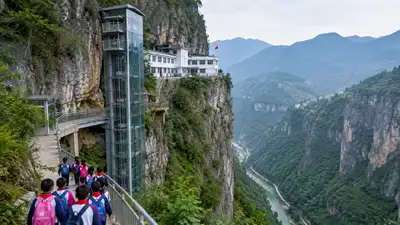
Image AI generated
The latest addition is an even taller elevator, standing 288 metres, or about 945 feet, above the canyon floor. Because of the difficulty and danger of the journey, in 2025, Xinhua reported that student Chen Honghan had once considered leaving school. Xinhua reported that parents in the village also organise a rota, with adults accompanying groups of children on their school journeys.
For children living in Nizhuhe village in southwest China, getting to school once involved far more than simply setting out for the day. The village lies deep within the Nizhu River Grand Canyon, where cliffs and narrow mountain paths separated homes from Guanzhai Village Primary School. A journey that could take around three hours on foot has now been reduced to roughly half an hour, thanks to a transport system built into the canyon itself. Students can travel by shuttle bus, rise hundreds of metres in a cliffside elevator, cross part of the canyon by cable car and then walk the final stretch to school. What began as a way to improve access for residents has also helped turn this remote mountain area into an increasingly busy tourist destination. For the pupils, the biggest change is the removal of the most dangerous part of the journey. Instead of navigating steep cliffside paths for hours, they can now make the commute through a series of engineered connections, making regular school attendance safer, faster and far more predictable. The route was not simply a long walk. Children had to negotiate rocky ground, steep sections and paths beside the cliffs. Even with those measures, getting to school remained a demanding part of everyday life. For pupils, though, the main difference is much simpler. A route that once required hours of walking is now broken into a sequence of relatively short rides. The children still have to take a shuttle, board an elevator, change to a cable car and walk the final stretch, but the dangerous climb is no longer the central part of getting to class.
Earlier attempts had been made to make the route safer, including cutting footholds into difficult sections, adding chains and building stone paths and railings.
Chen Honghan described the old journey to Xinhua: “Before, I had to carry my things and walk for three hours on mountain roads to get to school, and if I wasn’t careful, I could easily slip and fall. ”, according to the English news. Nizhuhe village sits deep inside the Nizhu River Grand Canyon, near the border of Yunnan and Guizhou provinces. Guanzhai Village Primary School is positioned much higher up, leaving children at the bottom of the canyon with a difficult route between home and the classroom. Some journeys took more than three hours each way, while reports have also described the round trip as taking close to six hours. The trip now involves several short stages rather than one exhausting climb. Children take a scenic shuttle for several minutes, transfer to the elevator and rise vertically by hundreds of metres before continuing by cable car. A final walk completes the route to school.
Before the new infrastructure was available, the shortest paths were steep, narrow and exposed.