
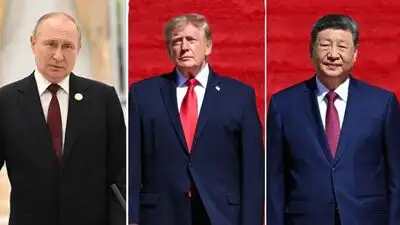
Vladimr Putin, Donald Trump, Xi Jinping
NEW DELHI: US President Donald Trump, Chinese President Xi Jinping and Russian President Vladimir Putin are among the world leaders expected to attend the Asia-Pacific Economic Cooperation (APEC) summit in China’s southern technology hub of Shenzhen on November 18 and 19. The summit will bring together leaders of 21 APEC member economies, which collectively account for approximately 62% of global GDP and around half of global trade. Beijing is hesitant to engage in nuclear disarmament discussions with Washington and Moscow because of the disparity in their nuclear capabilities, according to analysts. Because china occupies a dominant position in the global processing and supply chain for these materials, rare earth supplies are particularly important.
However, Tokyo has not formally confirmed whether Takaichi will attend the meeting. The gathering comes at a time of growing geopolitical tensions, trade uncertainties and competition over technology, with the possible interaction between the three leaders expected to draw particular attention. the presence of leaders from three major global powers has added a strategic dimension to this year’s meeting While economic cooperation remains the forum’s primary objective. From the Russia-Ukraine war and nuclear disarmament to US-China trade tensions and disputes in the Indo-Pacific, several issues could shape the discussions on the sidelines of the summit. Here are five key issues that make the China-hosted APEC summit important. The possible presence of Trump, Xi and Putin at the same gathering has put their diplomatic interactions under the spotlight. The three countries have overlapping interests in global security, nuclear weapons and international stability, but their strategic priorities often differ. One of the major issues is nuclear disarmament. The US and Russia possess considerably larger nuclear arsenals than China, which has been reluctant to participate in trilateral arms control negotiations. China maintains that negotiations should take into account the differences between the countries’ respective arsenals. The summit could provide an opportunity for informal exchanges on strategic stability, although APEC itself is primarily an economic forum and does not have a mandate to negotiate nuclear arms control agreements. The Russia-Ukraine war is another major issue that could feature in discussions between Trump and Putin. Washington and Moscow have a direct interest in the conflict, particularly over the prospects of ending hostilities and the future security arrangements in Europe. The presence of Xi adds another dimension to the diplomatic equation. China maintains close strategic and economic ties with Russia, while also seeking to position itself as an influential player in international diplomacy. However, analysts suggest that discussions between the US and Russia on Ukraine may not necessarily involve China. Any interaction between Trump and Putin could attract attention for indications of their respective positions on the conflict, negotiations and the broader relationship between Washington and Moscow. Relations between Washington and Beijing will be among the most closely watched aspects of the summit. The two countries have been attempting to maintain a trade truce, but analysts say both sides are falling short of commitments to an extended agreement. Trade restrictions, tariffs and access to critical minerals remain key areas of disagreement. They are essential for manufacturing electric vehicles, electronics, defence equipment and several advanced technologies. Artificial intelligence is another potential area of discussion. Both countries are competing for leadership in advanced computing, semiconductor technology and AI development. The US restrictions on advanced chip exports to China and Beijing’s efforts to strengthen its domestic semiconductor industry have added to the technology rivalry. US arms sales to Taiwan could also emerge as a contentious issue. Beijing opposes American military support for the island, which it considers part of its territory, while Washington maintains its commitments to Taiwan’s defence capabilities. Relations between China and Japan are another important issue to watch at the summit. China considers Taiwan part of its territory and has not ruled out the use of force to achieve reunification. Japan, meanwhile, views stability in the Taiwan Strait as important to its national security, given its geographical proximity to the island. Any interaction between Chinese and Japanese representatives at the summit could offer an indication of whether the two sides are willing to manage their differences through diplomatic engagement. Regional maritime disputes and instability in the Middle East are also expected to feature in discussions among APEC economies. China and the Philippines continue to face tensions over competing territorial claims and maritime activities in the South China Sea. The strategic waterway is an important international shipping route, carrying a substantial share of global trade. The participation of Philippine President Ferdinand Marcos Jr. will bring additional attention to the maritime disputes and the broader question of regional security. Meanwhile, instability in the Middle East poses risks to energy supplies, shipping routes and international supply chains. Disruptions to maritime traffic and energy exports could increase transportation costs, push up fuel prices and add to inflationary pressures across economies. For several Asia-Pacific countries that depend heavily on imported energy and international trade, maintaining stable shipping routes and securing energy supplies remain important economic priorities.
Why is Shenzhen hosting the summit?
Tensions between the two countries have persisted since November 2025, when Japanese Prime Minister Sanae Takaichi angered Beijing by suggesting that Japan could deploy its military if a Chinese move against neighbouring Taiwan also threatened Japanese territory. Established in 1989 in Canberra, Australia, APEC began as an informal dialogue involving 12 economies. The forum currently has 21 member economies: Australia, Brunei, Canada, Chile, China, Hong Kong, Indonesia, Japan, South Korea, Malaysia, Mexico, New Zealand, Papua New Guinea, Peru, the Philippines, Russia, Singapore, Taiwan, Thailand, the United States and Vietnam. China is hosting the APEC summit for the third time, following earlier meetings in Shanghai in 2001 and Beijing in 2014.
APEC uses the term “member economies” rather than countries, allowing participation by territories with different political and administrative arrangements, including Hong Kong and Taiwan. Join conversation Share your thoughts in the comments Be respectful · TOI community guidelines According to Chim Lee, senior analyst at the Economist Intelligence Unit, the choice of Shenzhen reflects both domestic and international considerations. The remarks added to existing disagreements over Taiwan and regional security. It has since developed into one of the region’s leading platforms for economic cooperation, trade and investment. Its decisions are based on consensus and are non-binding, with members undertaking commitments voluntarily. Despite being the world’s most populous country and a major Indo-Pacific economy, India is not a member of APEC. Shenzhen, located in southern China near Hong Kong, is a major technology and manufacturing centre. It is home to several prominent Chinese companies, including electric vehicle maker BYD, telecommunications company Huawei and technology giant Tencent. The city is also part of China’s Greater Bay Area, which includes Hong Kong, Macau and several cities in Guangdong province. Beijing aims to develop the region into a global hub for technology, innovation and finance. The summit provides China an opportunity to showcase its economic development, technological capabilities and ambitions in global trade, while demonstrating the city’s resilience amid geopolitical tensions. With Trump, Xi and Putin among the expected participants, the Shenzhen gathering will be watched not only for economic commitments but also for the diplomatic signals emerging from interactions between some of the world’s most influential leaders. You use AI every day. Now get your AI Quotient. Take the AIQ test.