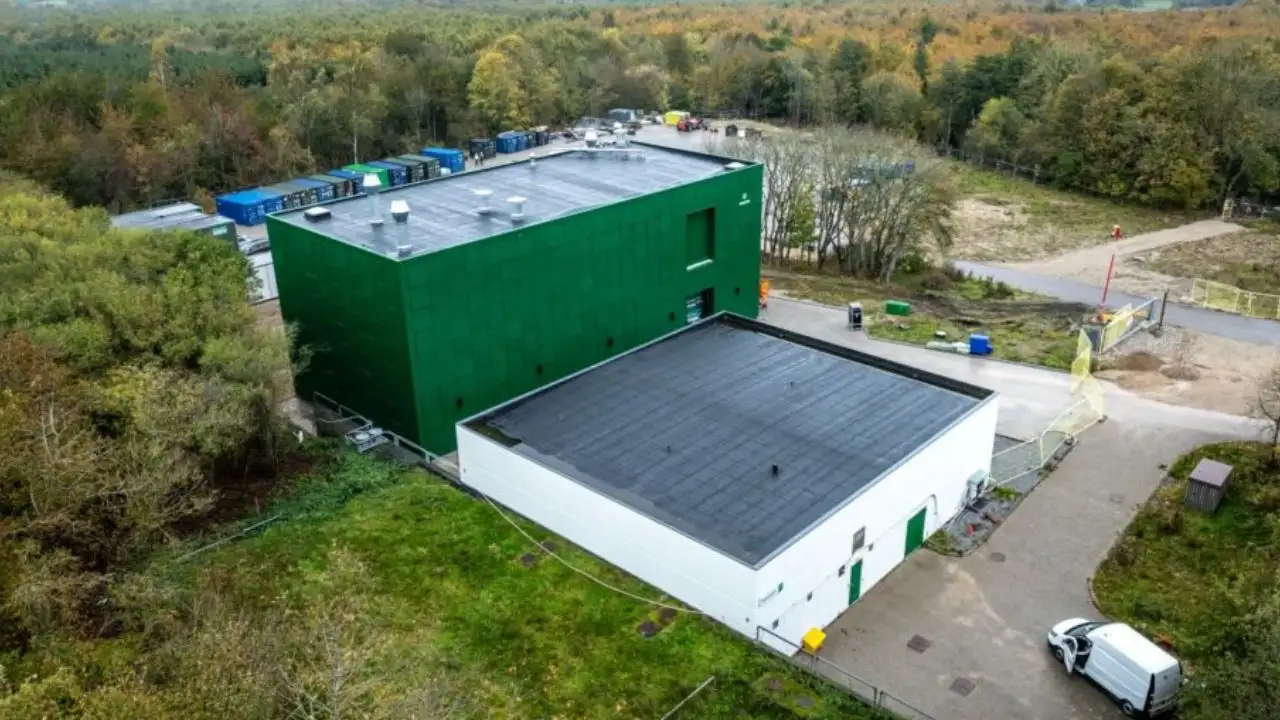
PC: Innargi
The first plant at Skejby began supplying heat to local homes on 31 October 2025, while construction and drilling work continue at other sites. The completed system is planned to have a total capacity of 110 megawatts and meet 20% of Aarhus’ district heating demand. The project is intended to operate for at least 30 years once completed and fully operational. The three facilities are expected to be completed in 2029, following an optimisation that reduced the planned number of locations from seven, according to Innargi (2025). The system is planned to comprise three facilities across the city by 2030. One is already operating at Skejby, where the first geothermal heat entered the district heating network in October 2025. PC: Innargi The project’s exploration phase included the drilling and evaluation of three test wells between 2023 and 2024. The planned combined capacity of the geothermal heating plants is 110 megawatts. This would equal 20% of Aarhus’ district heating demand, according to Innargi. The company expects the three facilities to be completed in 2029. The facilities are expected to operate for at least 30 years. Innargi’s project timeline lists preparations for the exploration phase in 2022, followed by exploration and appraisal between 2022 and 2025. Delivery of the first heat was scheduled for 2025, and the first Skejby facility began supplying the network in October that year. Construction of the remaining facilities is scheduled for 2026 to 2029. The company says the three facilities are expected to be completed in 2029, provided the project proceeds as planned.
The results confirmed a strong geothermal resource beneath the city, according to Innargi.
The company also said improvements in technology during the project’s first year helped optimise the plan. A geothermal heating project in Aarhus, Denmark, is moving towards a three-facility system designed to provide a substantial share of the city’s district heating. Innargi is working with district heating company Kredsløb. The project is being developed by Innargi in collaboration with Kredsløb, the district heating company in Aarhus. Drilling has commenced at the Port of Aarhus site, while the third plant is planned. Once fully built out, the three-site project is expected to be the largest integrated geothermal district heating system in the European Union. The facilities will transfer heat from a geothermal reservoir to the city’s district heating network, supplying heat to connected homes. Instead of developing the seven locations originally planned, the project will deliver the same heat from three locations. The revised approach forms the basis of the system being developed in Aarhus. The three facilities are planned across the city, including Skejby and the Port of Aarhus. The first facility at Skejby is already supplying heat, while work on the remaining facilities is continuing. The exploration work provided information used to assess the underground geothermal resource. The figure refers specifically to the city’s district heating demand, rather than all energy use across Aarhus. The system is designed to draw heat from the geothermal resource below the city and transfer it into the existing district heating network. Its planned capacity is intended to make geothermal energy a significant part of the city’s heat supply. You use AI every day. Now get your AI Quotient. Take the AIQ test.