
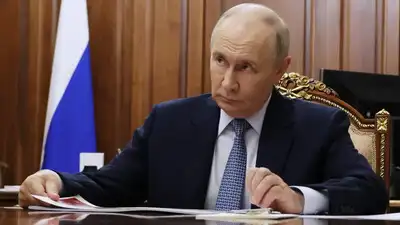
Europe fears Vladimir Putin may be preparing to test Nato somewhere beyond Ukraine’s borders. (AP photo)
One flashpoint that keeps coming up is the Suwałki Gap, a narrow strip of land barely 65 miles wide connecting Poland to the Baltic states of Lithuania, Latvia and Estonia. Would all 32 Nato members actually go to war over such a small piece of territory, especially one that could reignite fears of nuclear escalation? Russia Duma elections, held from 18 to 20 September, are now behind it, and it has been widely believed the result was never in doubt given how tightly the process is controlled by the Kremlin.
Poland prime minister Donald Tusk’s warning that Russia could strike Nato territory and make it look like an accident, what is considered a “deniable gray zone operations”. Lithuania’s prime minister, Mindaugas Sinkevičius, has been unusually candid about the mood on the ground as he told the BBC his country has drawn up plans for a “variety of scenarios”, including how to move elderly residents out of cities “smoothly” if the worst happened. “We face concrete threats, not on a daily basis, but we’re experiencing them and it’s a true reality for us,” Lithuania PM said.
For years, most European treated the war in Ukraine as something happening elsewhere, tragic but contained. However, that sense of distance has evaporated in the space of a few weeks. Britain has urged a its citizens to keep tinned food and water at home, while Germany is readying hospitals for mass casualties. Even Switzerland, a country that has avoided military alliances for two centuries, has adopted a security strategy built around defending itself if attacked. None of this appears to be a coincidence as it reflects a shared, growing fear that Vladimir Putin may be preparing to test Nato somewhere beyond Ukraine’s borders. Much of what worries Western officials is not a tank invasion but something harder to pin down. Drones drifting into Baltic airspace, sabotage at airports, cyberattacks, plots involving criminal networks operating far from Russia’s own territory. Individually, each incident can be denied or dismissed as an accident but likely form a pattern that lets Moscow probe Nato’s resolve without technically starting a war. If that corridor were ever cut off, even briefly, it would sever the Baltics from the rest of the alliance and force a very uncomfortable question. Nobody in Washington, Berlin or Paris can promise a confident yes, and that uncertainty is precisely what Moscow may be trying to exploit. What matters more to European planners is what comes after. Domestic elections tend to absorb a regime’s attention and resources. With that distraction removed, some officials fear Putin may feel freer to escalate pressure on Nato’s eastern flank, whether through further drone incursions, sabotage, or a more deliberate military manoeuvre designed to test the alliance’s unity. Lithuania borders the Russian exclave of Kaliningrad and has already seen Nato jets scramble to shoot down a drone that entered its airspace, an incident Britain’s defence secretary described by saying “we stand united, around the clock, in defence of every inch of Nato territory. Catch the latest World News and Live updates. Download the TOI app.