
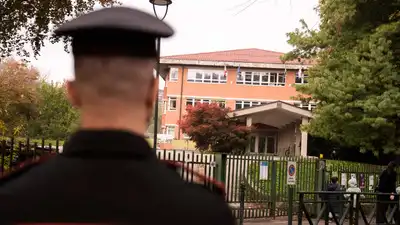
File photo: A police officer stands in front of the Matteotti Pellico institute as students get evacuated due to a bomb threat across all school sites in Turin, Italy
Education minister Giuseppe Valditara told Italian broadcaster La7 that at least 300 schools had received the alerts, adding that the number could rise. It was pretty violent,” 18-year-old student Anita Bartocci told AP reporters. The latest incident comes less than 10 days after a similar barrage of threatening emails reached more than 270 Italian schools on November 2, including institutions in Rome.
Because an email arrived from Russian hackers in which they said they would have killed everyone, “They are saying it was a bomb alert. Schools in Ireland, Scotland and Northern Ireland also received threatening messages, although no evacuations were reported in those countries.
More than 6000 schools across Italy received bomb threats and over 300 plus were evacuated on Wednesday after receiving identical bomb threat emails warning of a “genocide against the Italians”, triggering security sweeps and disrupting classes across the country. The email was signed by a sender identifying himself as “Mikhail Andropov, leader of the Vilayat of Misoginistan”, according to a government source familiar with the matter. Police are investigating the threats, a spokesperson for Rome police said. Police in Northern Ireland said they were conducting “urgent inquiries” after an email was sent to hundreds of schools. Police Scotland said it was treating similar messages as hoaxes and had not advised schools to evacuate, adding that its assessment was that they did not represent a credible threat. Irish police said they were aware of a “generic communication” sent to several educational institutions. He said law enforcement agencies were working to distinguish genuine dangers from threats made by people seeking to cause disruption, warning that such incidents could become increasingly frequent.
The threats were sent to educational institutions in several regions, from Rome to Friuli in the north and Basilicata in the south. Students and staff were moved to safe areas while police searched school premises for explosives. It claimed that a powerful explosive device with a remote detonator had been placed inside a school building and threatened to kill Italians in a mass attack. The message also claimed that a bomb had been planted in the engine of prime minister Giorgia Meloni’s car. A school in Rome informed parents that all students had been moved to safety and were being supervised by teaching staff. At a high school in Rome, students initially mistook the evacuation alarm for the recess bell and learnt about the threat only after leaving the building. Those alerts also prompted evacuations and security checks, but turned out to be false. The pseudonym Mikhail Andropov has appeared in other threatening emails sent in recent days to European television broadcasters. The sender has also reportedly claimed responsibility for threats targeting flights, although authorities have not established whether the incidents were connected. The school alerts come amid a wider pattern of disruption in Europe, including false threats against aircraft and cyberattacks on supermarket refrigeration systems. Recent attacks on cold-storage facilities have also affected blood banks in France, forcing staff to move blood supplies to alternative storage units. However, investigators have not established that the school threats, flight alerts and refrigeration attacks are connected or part of a coordinated campaign. Poll Do you believe the recent bomb threats to schools in Italy are genuine? Yes, I believe they are genuine threats. No, I think they are hoaxes. The interior ministry has also stepped up its response. The meeting concluded that some attacks were aimed not simply at disrupting systems but at spreading unfounded alarm, destabilising institutions and damaging their credibility. Former interior minister Marco Minniti called for a dedicated intelligence capability focused on cyber security, arguing that the threat required cooperation across political lines and should be treated as a matter of national security. You use AI every day. Now get your AI Quotient. Take the AIQ test.
3k+ users shared opinion today 5k+ users already voted today 3k+ users shared opinion today Share Opinion Italian defence minister Guido Crosetto described the school threats as an attempt to spread fear and uncertainty. Interior minister Matteo Piantedosi convened senior security officials on Tuesday to discuss the growing cyber threat.