
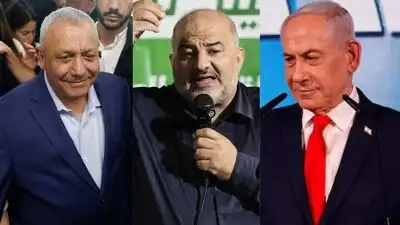
Gadi Eisenkot, Mansour Abbas, Benjamin Netanyahu
NEW DELHI: Arab parties emerge as kingmakers in Israel’s next government after Prime Minister Benjamin Netanyahu’s bloc fell short of a parliamentary majority, with their combined 19 seats potentially offering the opposition a path to power. Israel’s final election results confirmed that Netanyahu’s Likud-led bloc secured 53 seats in the 120-member Knesset, while the four main opposition parties won 48. The remaining 19 seats went to Arab factions, leaving all sides short of the 61 seats required for a majority. Likud emerged as the largest party with 27 seats, while opposition leader Gadi Eisenkot’s Yashar secured 21. The Joint List won 11 seats and Mansour Abbas’s Ra’am secured eight, taking the combined strength of the Arab parties to 19. The party joined the Bennett-Lapid government in 2021 and is seen as a potential partner in another arrangement that could keep Netanyahu out of power. Together, these parties could command 66 seats, although such an arrangement appears difficult given the opposition’s campaign pledge to remove Netanyahu from power.
However, disagreements within the opposition and uncertainty over cooperation with Arab factions could complicate efforts to form an alternative government. The results have put Arab parties at the centre of coalition negotiations, with their support potentially determining whether Netanyahu retains power or the opposition manages to form an alternative government. Netanyahu and finance minister Bezalel Smotrich, who leads Religious Zionism, have reportedly met to coordinate their efforts following the election. The opposition could also explore a broader unity government involving Likud, Yashar, Bennett’s B’Yachad and Lieberman’s Yisrael Beytenu.
Ra’am, led by Mansour Abbas, has previously participated in a governing coalition.