
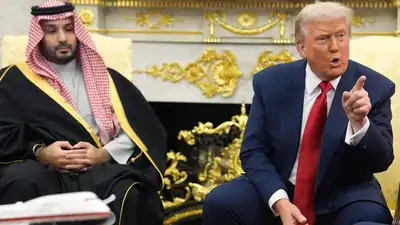
Trump’s reluctance comes as he is already dealing with the wider conflict with Iran.
Over the past two weeks, they have struck oil facilities in southern Saudi Arabia and launched an offensive along Yemen’s Red Sea coast.
Saudi Arabia has asked the US to carry out repeated air strikes against the Houthis, according to a person familiar with the discussions. United States President Donald Trump’s decision to hold back from joining Saudi Arabia’s military campaign against the Iran-backed Houthis has created a fresh strain between Washington and Riyadh, adding another complication to an already uneasy relationship. Washington has so far declined, leaving Riyadh to confront an expanding threat largely on its own. The hesitation is particularly significant for Crown Prince Mohammed bin Salman , who has spent years relying on the US as Saudi Arabia’s main security partner while also trying to position the kingdom as a major global centre for business, trade and tourism. The Houthis have intensified attacks on Saudi targets after declaring a blockade of the kingdom’s ports in July.
The Trump administration last week approved a potential $24.3bn sale of F-35 fighter jets to Saudi Arabia, although the aircraft would take years to be delivered.
Mona Yacoubian, director of the Middle East Program at the Center for Strategic and International Studies in Washington, said the US decision was creating further uncertainty in the relationship. “The US is wavering, and ultimately its decision, at least for now, not to join the Saudis is simply injecting more tension into the bilateral relationship,” she told FT. Retired Lieutenant General Karen Gibson, a former director of intelligence at US Central Command, said the episode could leave a lasting impression on the Saudi leadership. “MBS will not forget this,” Gibson said, adding that the hesitation shows that the “United States will not necessarily fight when Saudi Arabia believes its vital interests are threatened”. Liz Dent, a senior fellow at the Washington Institute for Near East Policy, said opening another front would be politically difficult with US midterm elections approaching in November. “It would be really difficult for [Trump] to get involved in yet another front of this war” ahead of the US midterm elections in November. However, she said the possibility remained that the Saudi request could be narrowed enough for Trump to accept. “It’s very possible that [MBS] is slowly reducing the ask and that Trump will at some point see something that is politically feasible for him,” Dent said. “There’s a lot more going on behind the scenes that’s keeping that relationship intact,” she added. A Saudi analyst, who declined to be named, said Riyadh remained frustrated but understood Trump’s approach. “There is a certain amount of frustration, but there’s also a recognition that’s the way [Trump] is,” the analyst told FT. The analyst said American aircraft could nevertheless have played an important symbolic role at the beginning of the conflict. A Houthi official told the Associated Press that the group was targeting Saudi vessels and would not attack US or other international ships. Trump has also said the Houthis agreed not to target American interests. But analysts said the limits of US involvement could have longer-term consequences. Yacoubian said it “does not instil a lot of confidence in the partnership” if Saudi Arabia “is going to be left out on their own because US assets are not currently threatened by this Houthi onslaught”. Asaad al-Shamlan of the Prince Saud al-Faisal Institute for Diplomatic Studies said the broader relationship remained “in a very good state”. Firas Maksad, managing director for Middle East and North Africa at Eurasia Group, said the disagreement could push Saudi Arabia further towards diversifying its security partnerships. “The space it leaves behind will create opportunities for strategic competitors,” he said.
The offensive has pushed back Saudi-backed forces supporting Yemen’s government and strengthened Houthi control around the Bab al-Mandeb Strait, one of the world’s key shipping routes. The Houthis also fired a ballistic missile towards Riyadh over the weekend, marking the first such attack on the Saudi capital since the conflict resumed. “It’s raising further concerns for the Saudis about what role they can rely on the US to play. Trump’s reluctance to intervene directly comes as his administration is already dealing with the wider conflict with Iran. Saudi Arabia has itself faced repeated Iranian strikes on infrastructure, while the closure of the Strait of Hormuz has added to the economic pressure affecting the Gulf. Trump also abandoned a US military plan in May to escort commercial shipping through the strait after Riyadh refused to allow American aircraft to use Saudi bases or airspace for the operation. Saudi officials had expressed concerns that the plan could trigger further attacks on Gulf states. Washington is also dealing with limited military resources and depleted ammunition stocks. Despite the disagreement, Washington has not abandoned Riyadh. The US continues to supply Saudi Arabia with weapons and intelligence, while Saudi forces also rely on American air-defence systems. “Saudi Arabia has all the capacity to bomb everything, and the US is giving us targeting information we need. The US has also maintained contact with the Houthis through talks facilitated by Oman. But he noted that Riyadh viewed the Houthi threat differently from Washington and Europe, where it is often seen mainly as a Saudi problem. “Riyadh has been diversifying its security partners while attempting an uneasy accommodation with Tehran. The tension in its relationship with Washington could accelerate that process. Catch the latest World News and Live updates. Download the TOI app.