
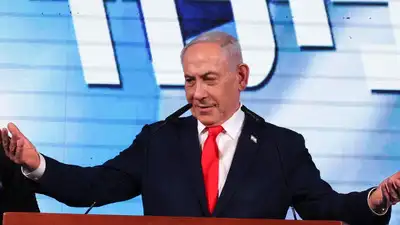
Israel’s international standing is also at stake following widespread criticism of its treatment of Palestinians in Gaza and growing violence by Jewish settlers in the occupied West Bank.
Israel’s election chief has ordered a probe into alleged foreign interference in the October 28 election, as Prime Minister Benjamin Netanyahu accused Arab-led parties of stealing the vote and warned of a foreign takeover of parliament. The allegations emerged on Thursday, October 29, as final results were awaited and neither Netanyahu’s bloc nor the opposition had secured a clear path to a majority in the 120-member Knesset. Four men were arrested on Thursday and were being questioned by the Lahav 433 major crimes unit over an alleged voter bribery scheme, Israeli police said. Local media projections put Netanyahu’s bloc at 53 seats, opposition parties at 48 and Arab-led parties at 19 in the 120-member Knesset. A party or bloc needs at least 61 seats to secure a parliamentary majority. Netanyahu’s chief rival, former military chief Gadi Eisenkot, has said he is open to working with Arab-led parties to reach the 61-seat threshold. Until 2021, no Arab party had joined an Israeli coalition government.
Because arab-led parties could help Netanyahu’s opponents secure a majority, the allegations have taken on greater political significance. The investigation could therefore influence the debate over whether opposition parties should cooperate with them to form a government. The Arab-led parties could therefore play a decisive role in determining the next government, even if they do not join a formal coalition.
Sohlberg said he could not confirm the validity of the claims but called for a thorough investigation. Sohlberg said the Shin Bet should use its authority to establish whether evidence supported or refuted the allegations. In a post on X, he said, “The Ra’amgate affair is an earthquake. Ahmad Tibi, head of the Joint List, told Army Radio that the opposition bloc had approached him about replacing the Knesset speaker. He said his party would support the bloc’s candidate and urged Eisenkot to show political courage. The Joint List described the election result as an “unprecedented show of strength” by Arab voters and praised Jewish voters “willing to swim against the tide of racism.
Central Elections Committee chair Justice Noam Sohlberg asked Shin Bet chief David Zini to investigate suspicions of improper influence through foreign funding and alleged electoral bribery. He asked Zini to submit findings within a week. Sohlberg directed the Shin Bet to investigate allegations that foreign entities had sought to influence the election through funding. In his letter to Zini, he wrote: “Serious suspicions have been brought to my attention regarding improper influence on the elections — exerted through funding provided by foreign entities acting against Israeli interests. He added: “While I cannot attest to the substance of these suspicions, it is my view that — given they involve foreign entities — there is an obligation to investigate them thoroughly. He called the investigation necessary to protect public confidence in the electoral process and democratic institutions. The allegations have not been independently established. Sohlberg did not identify the countries allegedly involved or provide further details about the suspected interference. Netanyahu accuses Arab parties of stealing elections Netanyahu seized on the investigation to intensify his attack on Arab-led parties and oppose any attempt by his rivals to form a government with their support. They stole the elections in Israel! He added: “This is an attack on democracy whose purpose is to lead to a foreign takeover of the Knesset, the Islamization of Israel, and the overthrow of right-wing rule in order to lead to retreat and defeat of the IDF in all arenas – and primarily Iran. The arrests followed the detention of three southern Bedouin men on election day, Tuesday, on suspicion of planning to pay people to vote for Ra’am. Ra’am has identified the men as party activists and denied the allegations. It remains unclear whether the arrests are connected to the Shin Bet’s investigation into suspected foreign interference. The separate bribery case has added to the political controversy surrounding the election. However, the arrests do not by themselves establish that the alleged scheme took place or that foreign actors were involved. The election has left Israel facing a difficult coalition-building process. Neither Netanyahu’s allies nor the opposition can currently reach that threshold on their own. Netanyahu’s Likud party has received the most votes, but that does not automatically guarantee him another term. The president traditionally asks the leader of the party with the most votes to try to form a government, although this is not a legal requirement. Small rallies were held overnight in Tel Aviv and Jerusalem in support of a coalition that includes Arab-led parties. Such cooperation would be politically significant. The brief participation of an Arab party in a coalition that year marked a historic departure. Netanyahu’s party is seeking to use the foreign interference allegations to discourage such an arrangement. The opposition, meanwhile, faces the challenge of building a majority without abandoning its central campaign pledge to remove him from power.
Channel 12 reported that the investigation was based on intelligence received by the Shin Bet and presented to Sohlberg.
Netanyahu’s Likud party suspects Qatar and Turkey may have funded get-out-the-vote groups targeting Arab citizens in Israel, according to Hebrew-language media reports. The reports said the channels allegedly used to transfer money to the organisations closely resembled those previously used to send funds for terrorism. However, the alleged involvement of Qatar and Turkey has not been established. Sohlberg did not identify any country as being behind the suspected interference.
“We demand to act immediately and with all means available to the Shin Bet and the police to investigate these crimes,” he said. Police have previously said there was “no supporting evidence” for Likud’s allegation that Arab-led parties stole the election. Netanyahu also called for immediate action by the security agency and police. Likud has argued that the allegations should rule out cooperation between Zionist parties and the Arab-led Ra’am and Joint List parties. It warned against forming a government with their support or replacing the Knesset speaker through what it described as votes bought with cash. The accusations remain claims made by Netanyahu and his party.
Final results expected after absentee ballots are counted
Israel’s election results must be certified by November 4. The swearing-in of the new parliament is scheduled for November 10. Arab citizens make up around 20% of Israel’s population. The Trump administration has spoken of new attacks after the US midterm elections on November 3. Such a development could also delay calls for a public inquiry into the security failures surrounding the Hamas-led attack on October 7, 2023, the deadliest extremist attack in Israel’s history, which triggered the war in Gaza.
The votes are not expected to alter the overall result dramatically, according to the available projections. “God willing, we will have something for us in the government, something that will bring us our rights,” said Brosli Elias, a resident of Nazareth. Final election results could come as early as Thursday evening, once around half a million absentee ballots have been counted. The ballots include votes from military personnel, diplomats, prisoners, hospital patients and others. President Isaac Herzog is expected to task someone with forming the next government the following week. Eisenkot has warned political actors against using the investigation to influence the timing of the process. If coalition negotiations fail after multiple attempts, Israel could face another election early next year. Herzog has indicated that he wants to avoid that outcome. The election has exposed divisions over security, religion and the future direction of Israel. One major issue is whether the fast-growing ultra-Orthodox population should continue to be exempt from compulsory military service. The question has become more contentious after three years of inconclusive wars and military losses. Netanyahu, Israel’s longest-serving prime minister, remains a polarising figure. He faces corruption allegations and accusations that he delayed a deal to secure the release of hostages held in Gaza for political gain. Israel’s international standing is also at stake following widespread criticism of its treatment of Palestinians in Gaza and growing violence by Jewish settlers in the occupied West Bank. Their stronger electoral showing has raised hopes among some voters that Arab-led parties could gain greater influence over government policy and parliamentary decisions. The possibility of further strikes against Iran could complicate Israel’s political situation. Experts have suggested that Netanyahu could use a renewed, large-scale conflict to push for a national unity government under his leadership. For now, the election investigation, the unresolved parliamentary arithmetic and the dispute over cooperation with Arab-led parties are likely to shape the next phase of government formation. The central question is whether Netanyahu can remain in power or whether his opponents can assemble a viable alternative. You use AI every day. Now get your AI Quotient. Take the AIQ test.