
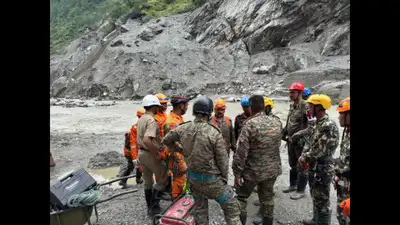
Beginning on September 24, Nepal faced catastrophic rainfall that triggered numerous landslides and floods, resulting in the tragic loss of 27 lives.
At least 27 people have been killed in Nepal by the rain related calamities since September 24, according to the authorities. Since September 24, twenty individuals have died in landslides, four in floods, and three in accidents involving severe rainfall, according to the administration. 114 cattle were slaughtered and 1,082 households were impacted by the disasters. Additionally, 31 bridges were damaged by landslides and floods, and 227 homes were totally destroyed while 142 others were partially damaged. Between September 24 and 27, 542 rain-related catastrophe situations were documented, according to the NDRRMA. The Department of Hydrology and Meteorology reports say that over the four days ending September 27, 186 rainfall measurement stations nationwide recorded more than 100 mm of precipitation. At 544.2 mm, Dedhgaun in Nawalparasi (Bardaghat Susta East) had the most rainfall, followed by Panchase in Kaski with 500.2 mm and Atraulitaar in Tanahun with 472 mm. Over 980,000 individuals received flood-warning SMS notifications from the NDRRMA via telecom service providers. Some 2,000 individuals who were at risk of flooding were moved to safer locations, according to NDRRMA spokeswoman Shanti Mahat. On September 27, a helicopter rescued 78 individuals, who were in danger in Pauddhar of Annapurna Rural Municipality-5 in Myagdi and transported them to a safe location, according to Mahat. Heavy rains caused landslides in Chame, Manang, on the afternoon of September 27, according to local media sources. Near Ridi and Rudrabeni, more than 50 meters of road were destroyed, and around 30 meters of road were cut at Dedhgaun. Starting on September 28, water levels in significant rivers, including as the Narayani and Gandaki, began to progressively drop and the situation was generally returning to normal, according to the NDRRMA. On August 26, the Bhotekoshi River, which flows south from the Himalayan border area, brought flooding downstream, destroying homes, cars, highways, bridges, and hydropower projects. Over 1,450 people were killed, and about 5,000 are still missing.
Kantipur reported that the swelling river was cutting away portions of the road and causing landslides at many sites.
A helicopter was used to rescue people, who were stranded by landslides, and floods in isolated areas including Jajarkot, Myagdi, and Baglung, according to her. Additionally, four individuals, who were stuck on an island in Jajarkot’s Bheri River were flown, according to PTI report. A bridge that had been buried started to resurface by Monday, and the lake’s water level had dropped by around a meter, according to local media accounts.
The National Disaster Risk Reduction and Management Authority (NDRRMA) reports that eight people have been hurt in landslides and floods caused by severe rainfall, while four individuals are still unaccounted for. The meteorological experts attributed the severe rains to moisture-laden winds from the Bay of Bengal and a low-pressure region near Uttar Pradesh in northern India. For search, rescue, and relief efforts, security troops from the Nepali Army, Armed Police Force, and Nepal Police were sent in. Flood and landslide debris from Ghatte Khola partially blocked the Marsyangdi River, allowing the two streams to join and form a lake. As the river surged, people in Chame and the surrounding regions evacuated to caves, forests, and other safer places. Along the Kaligandaki corridor, the water also caused damage to roads and bridges. The NDRRMA sent out notifications to local bodies and authorities in the affected districts, requesting that they remove families residing in dangerous regions to safer sites and keep a high degree of surveillance in downstream areas. The most recent floods and landslides occur, when Nepal is still recuperating from the catastrophic flash floods that occurred close to the border between Nepal and Tibet last month. You use AI every day. Now get your AI Quotient. Take the AIQ test.